Building One Regional Voice: Highlights from the 2025 Annual Meeting

Building One Regional Voice: Highlights from the 2025 Annual Meeting

Key takeaways on competitiveness, collaboration, and regional readiness as leaders across Greater Washington join the Board of Trade for its 136th Annual Meeting. 

The Greater Washington Board of Trade brought together more than 400 leaders from across business, government, higher education, and the nonprofit sector for the 136th Annual Meeting, presented by Kaiser Permanente. Attendees left with one clear message: Greater Washington is entering a defining era—one where collaboration, shared purpose, and a unified regional voice will determine our competitiveness for decades to come. 

The program opened with Emily Holliman, Interim Regional President and COO for Kaiser Permanente of the Mid-Atlantic States, who underscored the vital relationship between community health, economic strength, and workforce well-being. She spoke to Kaiser Permanente’s dedication to cultivating thriving communities—reinforcing why the organization has proudly served as the presenting sponsor of the Annual Meeting for 11 consecutive years. 

A Region at an Inflection Point 

Board of Trade President & CEO Jack McDougle delivered a candid and inspiring assessment of the past year—describing 2025 as consequential for the organization and the region. 

Greater Washington is experiencing profound shifts: 

  • The federal government is transforming how it operates, hires, invests, and uses physical space. 
  • AI, automation, electrification, and digital infrastructure are accelerating competitive pressures. 
  • Jurisdictions face resource constraints and competing priorities that require new levels of boldness and collaboration. 

McDougle emphasized that the pace of change won’t slow down—and we cannot afford to either. To meet this moment, regional leaders must move faster, think bigger, and work together more intentionally. 

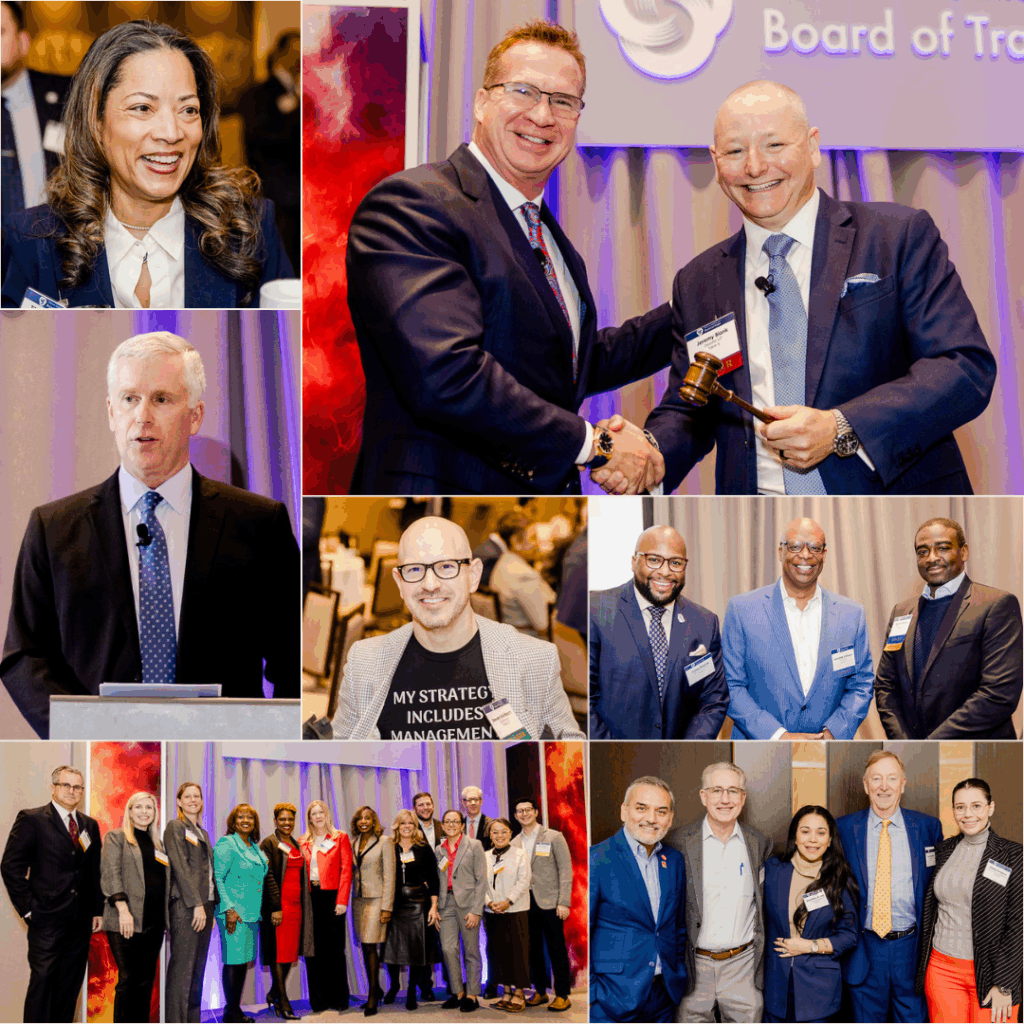
Take a look at more photos from our Annual Meeting!

Regional Collaboration: From Aspiration to Reality 

A central theme echoed throughout the meeting: the future of Greater Washington depends on a new kind of regional collaboration—one that is durable, consistent, and grounded in shared priorities. 

McDougle highlighted several examples where this collaborative approach is taking hold: 

DMVMoves & the Future of Transit 

  • Metro was recognized as APTA’s 2025 Transit Agency of the Year, reflecting major progress in safety, reliability, and modernization. 
  • Through DMVMoves, leaders across D.C., Maryland, Virginia, WMATA, COG, business, and labor united behind recommendations for dedicated capital funding and a more integrated regional bus network. 

The DMV Monitor: A Shared Data Backbone 

  • In partnership with Brookings and COG, the Board of Trade helped shape the new DMV Monitor, providing a unified, regionwide framework for tracking economic and quality-of-place indicators. 

Talent Capital AI & Workforce Transition 

  • Working with the Consortium of Universities, COG, and D.C.’s education leaders, the region launched Talent Capital AI to support federal workers impacted by shifting workforce needs and technological change. 

The Potomac Conference: Building a Regional Formula 

  • The Board of Trade, Greater Washington Partnership, COG, and the Consortium of Universities are working together to create a shared structure for regional action on mobility, energy, competitiveness, talent, and governance. 

These efforts reflect a powerful shift—from fragmented decision-making to collective regional problem-solving. 

Toward a Unified Regional Voice 

One of the most resonant messages of the morning centered on identity:
Greater Washington lacks a common narrative and shared language about who we are—and who we aspire to be. 

For months, the Board of Trade has been working with APCO and member leaders to begin shaping a foundational story of the region. Attendees previewed early concepts that explore what defines the DMV and what truly differentiates us on a national and global stage. 

This work is at its beginning, but the goal is clear:
to build a unified, compelling regional voice that aligns leaders, strengthens competitiveness, and reflects the dynamism of our collective future. 

Learn More & Register for Our Next Signature Event

Keynote: How Purposeful Leaders Defy Drift 

Keynote speaker Steve Goldbach, Principal and Sustainability Leader at Deloitte US, delivered a timely message from his book Hone: How Purposeful Leaders Defy Drift. He urged leaders to avoid “wait-and-see” decision-making—arguing that in times of rapid change, the status quo is often the riskiest strategy. 

Goldbach encouraged the region to embrace continuous honing—small, purposeful adjustments that realign systems and structures with the future we want to build. His insights reinforced the regional themes of adaptability, shared responsibility, and stepping boldly into change. 

Learn more about our Keynote Speaker here

Celebrating a High-Impact Year 

Outgoing Board Chair Jeremy Blank of Deloitte highlighted major achievements that reflect the Board of Trade’s growing reach and energy: 

Membership & Engagement 

  • 95% of member companies engaged in programs and events 
  • 91% projected retention—well above association norms 
  • 29 new member organizations joining in 2025 

Thought Leadership & Visibility 

  • 12 million impressions through the WTOP “Regional Business Insights” series
  • High-impact placements across regional media outlets
  • Consistent presence on stages and at tables where the future of the region is being shaped

Blank emphasized that the Board of Trade is not a passive membership—it is an active platform. “Membership is like a gym,” he said. “You get out what you put into it.” 

New Leadership, Shared Momentum 

Incoming Chair Tyler Anthony of Pepco Holdings accepted the gavel, expressing his commitment to continuing the region’s positive momentum. 

Anthony highlighted three imperatives for 2026: 

  • Deepening regional collaboration across sectors 
  • Championing the big issues—transit, talent, economy, and infrastructure 
  • Strengthening the collective regional voice 

He encouraged organizations to continue sending their best people into this work, treating the Board of Trade as a regional team, not a collection of individual institutions. 

Looking Ahead: A Region Ready to Move Together 

This year’s Annual Meeting showcased something powerful:
Greater Washington is not waiting for perfect clarity. It is choosing to act—together, with purpose, and with a growing sense of shared identity. 

As the region undergoes generational transformation, the Board of Trade will continue to convene the people, data, partnerships, and strategic insight needed to move in one direction as one regional voice.  

Thank you to everyone who joined us. Together, we are building a Greater Washington that is bold, collaborative, unified—and ready for the future. 


Thank you to our sponsors for their continued support 

Big Bets, Real Discipline: What We Heard from Governor Wes Moore

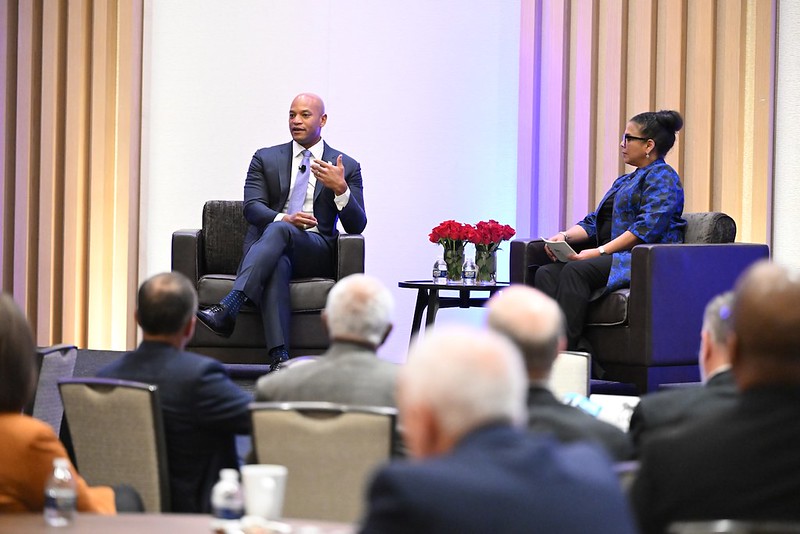
The Board of Trade hosted Maryland Governor Wes Moore on November 18 for a fireside chat with MGM National Harbor President & COO Melonie Johnson, bringing together executives from business, nonprofit, academia, and government from across the Capital Region to talk frankly about growth, risk, and what comes next for Maryland and the region’s economy. 

The backdrop was serious. Maryland is staring at a projected budget gap of roughly $1.4–$1.5 billion in fiscal year 2027, even after earlier tax and spending changes. At the same time, the state is positioning itself to lead in quantum, AI, life sciences, and other high-growth sectors through major initiatives like the “Capital of Quantum” and a new AI partnership with Anthropic and Percepta. 

Local coverage rightly highlighted the tension: WUSA9 framed the afternoon around “economic revival amid budget deficit concerns,” while WTOP focused on Moore’s call for business leaders to “take big bets” in 2026. 

Our lens is simple: what does all of this mean for leaders across the Capital Region? 

 Why this moment matters for our members

Maryland is a core pillar of the regional economy. When its fiscal strategy or growth model shifts, the effects don’t stop at the state line; they ripple through hiring, investment, and competitiveness across D.C., Maryland, and Virginia. 

Two realities framed the discussion on stage: 

  • Federal dependence is no longer predictable. Coming out of the longest federal government shutdown in U.S. history, Moore was direct about how much of Maryland’s economic and fiscal base is currently tied to the federal government and how much less predictable that arm has become.  
  • The opportunity set is changing fast. Initiatives like the $1 billion “Capital of Quantum” and the state’s AI partnership are designed to reposition Maryland around sectors that can drive long-term revenue, higher-wage jobs, and regional competitiveness. 

For employers, that combination of constraint and opportunity is exactly where strategy gets tested. 

PG8_9958

Big bets with guardrails 

Moore framed his agenda around three imperatives: 

  • Grow the economy. Make it easier for companies to come to Maryland, stay in Maryland, and scale, with an emphasis on durable private investment rather than short-lived incentives. 
  • Diversify the economy. Strengthen sectors like quantum and advanced computing, cybersecurity, life sciences, climate and resilience solutions, and other innovation industries so Maryland isn’t overly exposed to federal spending cycles and job cuts. 
  • Move faster. He challenged both government and business to move beyond a culture of “no and slow” and toward a more disciplined “yes and now”; shortening timelines, reducing friction, and being more intentional about where risk is worth taking. 

For the business community, the ask was straightforward: align your 2026–27 “big bets” with the places where Maryland and the Capital Region are deliberately building capacity, take risks, and be part of making those bets succeed. 

A regional lens on competitiveness 

A consistent theme of the afternoon was regionalism. As WTOP noted, Moore told the room that when he pitches companies, one of the main things he sells is not just Maryland in isolation but the strength of the broader DMV. 

What resonated most was his emphasis on working with D.C. and Virginia on transit, talent, and energy. These are regional systems, and if we align them, we strengthen Maryland and the broader Capital Region. That’s the kind of collaboration our business community is ready to support. 

Read more on the Board of Trade’s regional focus discussed in recent publications:

What’s next 

For the Board of Trade, this fireside chat is the continuation of a deeper set of conversations and workstreams. Be part of the conversation and growing our region’s economy – the Board of Trade calls on you to:  

  • Stress-test your 2026–27 strategy against the region’s direction. As you plan capital investments, expansions, and hiring, ask where they intersect with Maryland’s and the Capital Region’s emerging strengths in quantum, AI, cybersecurity, life sciences, and resilience. 
  • Engage on both growth and discipline. Fiscal constraints make it more important to advance projects and policies that deliver long-term economic value. The business community’s voice will be critical in shaping which investments move forward and how they’re structured. 
  • Stay at the regional table. Through DMV Moves, the Potomac Conference, and ongoing executive convenings, the Board of Trade will continue bringing business, government, and civic leaders together to tackle transit, energy, digital infrastructure, and talent issues at the scale they actually exist: the Capital Region.  

We’re grateful to Governor Wes Moore for his candor, to Melonie Johnson and MGM National Harbor for hosting, and to every member who joined us. 

This is not a moment for “no and slow.” It’s a moment for informed, collaborative “yes and now” and our region’s business and civic leaders will be central to making that real. 


Thank you to MGM National Harbor for helping support the Board of Trade’s mission. 

GWBOT October 2025 Newsletter

The Board of Trade remains focused on advancing the priorities that matter most to Greater Washington. This October newsletter shows a variety of engagements we have had across Greater Washington with members and public officials, while also showcasing meaningful updates on priorities we are following in the region. We also have a variety of member news updates that showcase regional collaboration!

Read our October 2025 Newsletter here

Building Momentum for RFK Stadium Redevelopment Project

The future of RFK Stadium is moving closer to reality after September 17, when D.C. Council voted again in favor of the RFK stadium redevelopment legislation. Redeveloping RFK is not just about building a stadium; it’s about creating a 21st-century destination that reflects the values and ambitions of the District and its residents. The Board of Trade is proud to be a leading voice in shaping that future, and we will remain engaged as the process advances.  (Statement: D.C. Council final vote for redevelopment funding on Sept. 17)

This project represents more than bricks and mortar; it is a chance to reshape an iconic site into a destination that drives economic growth, improves connectivity, and enhances the quality of life across the District and region. The project will create 14,000 construction jobs and 2,000 permanent jobs, generating $4 billion in tax revenue and more than $15.6 billion in direct spending over 30 years. Spanning about 180 acres of the former RFK Stadium site, the campus will transform today’s underused riverfront parcel into a vibrant mixed-use neighborhood.


This RFK Stadium stie redesign rendering is provided by KATO. See more here: https://www.rfknewstadium.com/


Earlier this year, the Board of Trade, city officials, and other local and regional groups testified before the D.C. Council in support of legislation that would unlock the potential of the RFK site and allow the city to move forward with a transformative vision, including: 

  • Letters of support were submitted to the D.C. Council outlining the opportunity to transform the District through a 65,000-seat roofed stadium for the Washington Commanders, designed to host not only football but also up to 200 annual events, including concerts and cultural gatherings.
  • In initial testimony before the D.C. Council, the case was made for legislation to unlock the potential of the RFK site and advance a broader vision for redevelopment. The testimony highlighted priorities such as strong transit connections, economic competitiveness, and community benefits. Specific elements included 6,000 new housing units (with at least 30% affordable), hotel rooms, new restaurants and retail, parking, an $89 million youth sportsplex, activation of the Fields at RFK, expanded green space, riverfront access, and walkable parks. (read our testimony here 
  • Subsequent testimony supported the RFK Stadium funding bill and underscored the importance of timely action to prioritize infrastructure, affordable housing, and adherence to construction timelines. (read our second testimony here) 
  • In addition, Mayor Bowser and community leaders convened engagement events, including a rally at the Wilson Building and a stakeholder event hosted by the Mayor, to highlight the redevelopment’s potential business opportunities. These gatherings drew attention to the broad community and economic impacts of this once-in-a-generation project.

Throughout the entire process, we have been in ongoing dialogue with the Washington Commanders to ensure that the project balances economic competitiveness with community needs — from workforce opportunities to improved transit access and mixed-use development that serves residents and businesses alike. With upgraded utilities, new roadways, improved transit access, and vibrant hospitality districts like the Riverfront and Plaza, the project will revitalize the site and surrounding neighborhoods. It will serve as a community anchor by blending housing, commerce, recreation, and entertainment into a powerful driver of growth for the District.

The Board of Trade will continue to champion this redevelopment as an engine of growth, connectivity, and opportunity for the entire region. We look forward to continuing conversations with the Commanders, community leaders, and stakeholders to unlock all that the RFK site has to offer.  

Learn more about how we engage with leaders at the federal, state, and local levels to ensure that the voices of Greater Washington’s business community are heard: https://www.bot.org/business-policy-greater-washington-dc/

Connect This Fall: Upcoming Board of Trade Events for Our Members

Fall at the Greater Washington Board of Trade is when the energy of our region truly comes alive. Our calendar is brimming with gatherings that spark ideas, deepen relationships, and put business leaders at the center of conversations shaping what’s next for Greater Washington.

This season blends time-honored traditions with fresh opportunities—signature celebrations, exclusive executive forums, and policy discussions that set the tone for the months ahead. Many of these are member-only, designed to give our community unparalleled access to peers and decision-makers in trusted, candid settings.

Momentum is building, and you’ll want to be part of it. Explore the full calendar at www.bot.org/events or reach out at [email protected] to secure your place before these high-demand opportunities fill.

***These events below are for members of the Board of Trade and not open to the general public***

🍂Upcoming Fall Programs & Events🍂

Professional Development: Leadership Through Storytelling & Connection

The third session of the TD Bank Morning Star Series takes leadership learning out of the boardroom and into the O Museum. Through a guided scavenger hunt, participants will explore new ways to spark conversations, share stories, and build authentic connections.

Learn More & Register


Policy Briefing: Federal Priorities & Regional Impact

Executive Level, Members Only

Join fellow executives for a tactical briefing on the federal policies shaping the Capital Region. John Hallmark, EY’s U.S. Political & Legislative Leader, will share timely updates on looming deadlines and what they mean for our economy, workforce, and operations.

Space is Limited – Reserve Your Seat Today


Signature Event: Fall Business Classic

One of Greater Washington’s most beloved traditions returns—this year at Signal House, a stunning rooftop venue in Union Market. Join hundreds of business, government, and civic leaders for an evening of networking, connection, and celebration in one of D.C.’s most vibrant neighborhoods.

Register Today


Regional Insights: 2025 Hunger Report

Fresh insights from the 2025 Hunger Report reveal powerful connections between food security, workforce readiness, and regional competitiveness. Join Radha Muthiah, President & CEO of the Capital Area Food Bank, for a dialogue on what the data means for business leaders and how collaboration can drive resilience.

Join the Conversation


Executive Insights: Economic Trends & Regional Competitiveness

Executive Level, Members Only 

As Greater Washington faces budget uncertainty, housing challenges, and workforce shifts, business leaders need clear perspective on the economic forces shaping our region. In this private, conversational roundtable, Tom Barkin, President & CEO of the Federal Reserve Bank of Richmond, will share the Fed’s outlook and engage members in candid dialogue on competitiveness.

Space is Limited – Reserve Your Seat Today


Leadership Insights: Adapting to Policy Change

Federal policymaking is moving fast, with ripple effects on budgets, workforce priorities, and the region’s competitiveness. Guided by experts from K&L Gates, this session will cut through the noise and connect national decisions to practical strategies for Greater Washington’s business leaders.

Join the Conversation


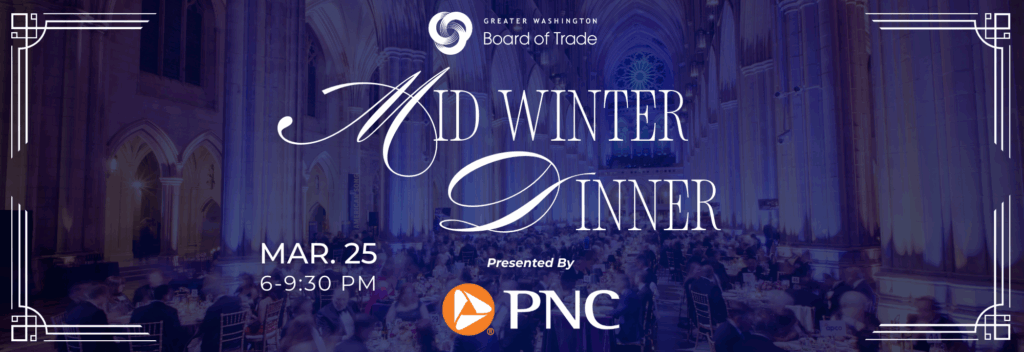
Signature Event: 136th Annual Meeting

Since 1889, the Board of Trade’s Annual Meeting has brought members together to celebrate progress and set priorities for the year ahead. This cornerstone gathering is a must-attend for industry leaders, offering unmatched networking and a shared vision for Greater Washington’s future.

Register Today


Executive Networking: Virginia Mae Center Salon

Executive Level, Members Only 
Experience the beauty of the newly renovated Virginia Mae Center while connecting with fellow executives in an intimate, year-end gathering. Enjoy seasonal flavors and candid conversation as we close the year with perspective and shared connections.

Secure Your Spot

Both man and machine are causing big changes in the Washington, D.C. region | WTOP

This content is sponsored by EagleBank and was originally published on WTOP. 

“Our region is undergoing a fairly significant transformation,” said Jack McDougle, the President and CEO of the Greater Washington Board of Trade, “probably the greatest transformation it’s ever seen.”

The reasons: major shifts in the federal government and the rise of artificial intelligence.

However, McDougle believes government restructuring actually presents an opportunity.

“For the longest time, our region has aspired to develop an economy that wasn’t quite as reliant on the federal government… this is accelerating it.”

“Our region comes to this with a significant resource base,” he said. That includes a highly skilled workforce, a significant university network and other types of research and development activities.

McDougle adds that this region boasts “the third most productive biotech corridor in the country.”

“We’re the fifth largest recipient of venture capital money in the country,” he said.

Further, he states the region will still have a strong presence in the hospitality and tourism area. “If you think about our cultural assets in this region, and our monuments and our parks, that still is a significant draw for a global audience,” he said. “It still will be a pretty broad-based economy.”

Finally, some federal employees are leaving their jobs and starting their own businesses, “which is pretty interesting,” he said.

While those changes are the largely end result of political actions, there are also concerns that A.I. could affect the local economy.

Artificial intelligence itself may not be coming for your job, McDougle said, “but somebody who is equipped with artificial intelligence will be.”

“So it’s in everyone’s interest to figure out how it is that they will work with, use and learn to coexist with artificial intelligence.”

The region’s many small businesses could stand to benefit from A.I.

For businesses grappling with talent issues, “utilizing artificial intelligence now can make them more effective, quicker, (and) more productive with their current staff,” McDougle said.

“The challenge, though, is how do they really adopt those tools? How do they use those tools, and how do they invest in them?”

Despite all the upheaval, McDougle describes himself as optimistic about the region, long-term, because of the resources we have.

“And when you think about…deploying those resources more effectively, we’d be untouchable.”

Those resources include not only access to the federal government, but also “something that’s different about our workforce.”

“Our workforce is a little different because it’s mission driven,” McDougle said. “It’s civic-oriented.”

“And so if we can get out in front on the policy side, the regulatory side, the technology side, the capital and investment side, that’s a really unique combination that no one else has.”

GWBOT August 2025 Newsletter

The Board of Trade remains focused on advancing the priorities that matter most to Greater Washington. This August newsletter shows a variety of engagements we have had across Greater Washington with members and public officials, while also showcasing meaningful updates on priorities we are following in the region. We also have a variety of member news updates that showcase regional collaboration!

Read our August 2025 Newsletter here

GWBOT July 2025 Newsletter

The Board of Trade remains focused on advancing the priorities that matter most to Greater Washington. This July newsletter shows a variety of engagements we have had across Greater Washington with members and public officials, while also showcasing meaningful updates on priorities we are following in the region. We also have a variety of member news updates that showcase regional collaboration!

Read our July 2025 Newsletter here

So Much Power, No Platform: Executive Leaders Discuss Fixing the Disconnect in Regional Progress

The Capital Region stands at a pivotal crossroads. We have all the assets we need to be one of the world’s most competitive, inclusive, and resilient economic hubs — yet we lack the collective operating system to truly activate them.

At the Board of Trade’s recent Executive Leadership Roundtable in partnership with Comcast, leaders across business, education, and civic sectors agreed: Our region is not short on resources. We are rich in capital, talent, innovation, and infrastructure, but these elements operate in silos.

We heard a striking metaphor: “Our region is an app store without an operating system.” We have incredible individual capabilities, but they are not plugged into a cohesive system that drives shared outcomes.

Participants emphasized that to transform, we must:

  • Move from a zero-sum mindset to shared growth.
  • Align educational and workforce systems with the region’s evolving economic identity.
  • Streamline regulatory frameworks to support speed and innovation.
  • Shift from process-driven philanthropy to outcome-focused investment.


Inclusion remains a central imperative. With deep disparities in literacy, income, and access to opportunity — for example, 47% of adults in Ward 7 read at a first-grade level — we cannot build a prosperous region without confronting these foundational issues.

As one participant noted, “We have the assets of a Silicon Valley, but not the mindset.” Changing this requires collective vision and action across public and private sectors, underpinned by bold leadership.

Participants explored forward-looking strategies to ensure the Capital Region remains competitive, resilient, and inclusive. Insights from this session will help shape ongoing regional dialogues and inform the collaborative work of the Potomac Conference — a platform designed to synthesize diverse perspectives and surface shared priorities across jurisdictions and sectors.

The time to act is now. We can no longer afford to admire our challenges — we must design, build, and sustain the systems that will define our shared future.

Thank you to Comcast and its government affairs executive, Misty Allen, for partnering and helping us facilitate this discussion. Learn more about the work of Comcast’s Project UP and how this initiative is helping expand internet access around Greater Washington and the United States: https://bit.ly/4lOoMQU

Featured Members