2025 Year in Review and 2026 Outlook

2025 Year in Review and 2026 Outlook

A YEAR OF CONSEQUENTIAL CHANGE

In 2025, the Greater Washington Board of Trade played a pivotal role in guiding our region through a year of consequential change. As federal transformation, technological disruption, and new economic pressures reshaped the landscape, we focused on opportunities, collaboration, and data-driven action.

You’ll see that reflected in our work, charting a more sustainable future for regional transit, standing up shared data and talent tools, and supporting underrepresented entrepreneurs. These are core ingredients of a competitive economy and a stronger story for Greater Washington.

This progress is possible because of you. To our officers, executive committee, board of directors, committee chairs, regional partners, and all our members—thank you. Your leadership, engagement, and commitment power this work and strengthen our community as a whole.

As we look to 2026, the Board of Trade remains focused on helping define a more unified voice; accelerating progress on mobility, energy, and capital; and building the systems and solutions that will define our next chapter.

LEADING REGIONAL PROGRESS

In partnership with our members and community, the Board of Trade advanced a wide range of work across the region this year. The examples below are a snapshot of that progress, not an exhaustive list, illustrating how we are helping to shape regional systems, align decision-makers, and move practical solutions forward for Greater Washington.

STRATEGY IN ACTION

This year, the Board of Trade didn’t just set strategic priorities; we moved them. We were deliberate about aligning our policy work, programming, and public voice so they reinforced one another and pushed the region in the same direction; advancing a shared agenda around transit, talent, innovation, technology, and resilience.


IMPACT THROUGH ENGAGEMENT

Our impact in 2025 shows up in who engaged, how often, and what we did with that engagement. Members used Board of Trade platforms as working rooms; testing ideas, sharpening priorities, and advancing regional solutions. At the same time, our media and digital channels carried that work beyond the room, amplifying the region’s story and giving business a stronger, more consistent voice in the public conversation. The metrics on this page reflect that story of depth, breadth, and growing influence.

  • This year, welcomed 29 new member organizations, representing strong momentum heading into 2026.
  • Achieved an outstanding 91% retention rate, far surpassing association benchmarks, and had over 90% of member organizations engaged in at least one program, demonstrating deep commitment across our regional network.
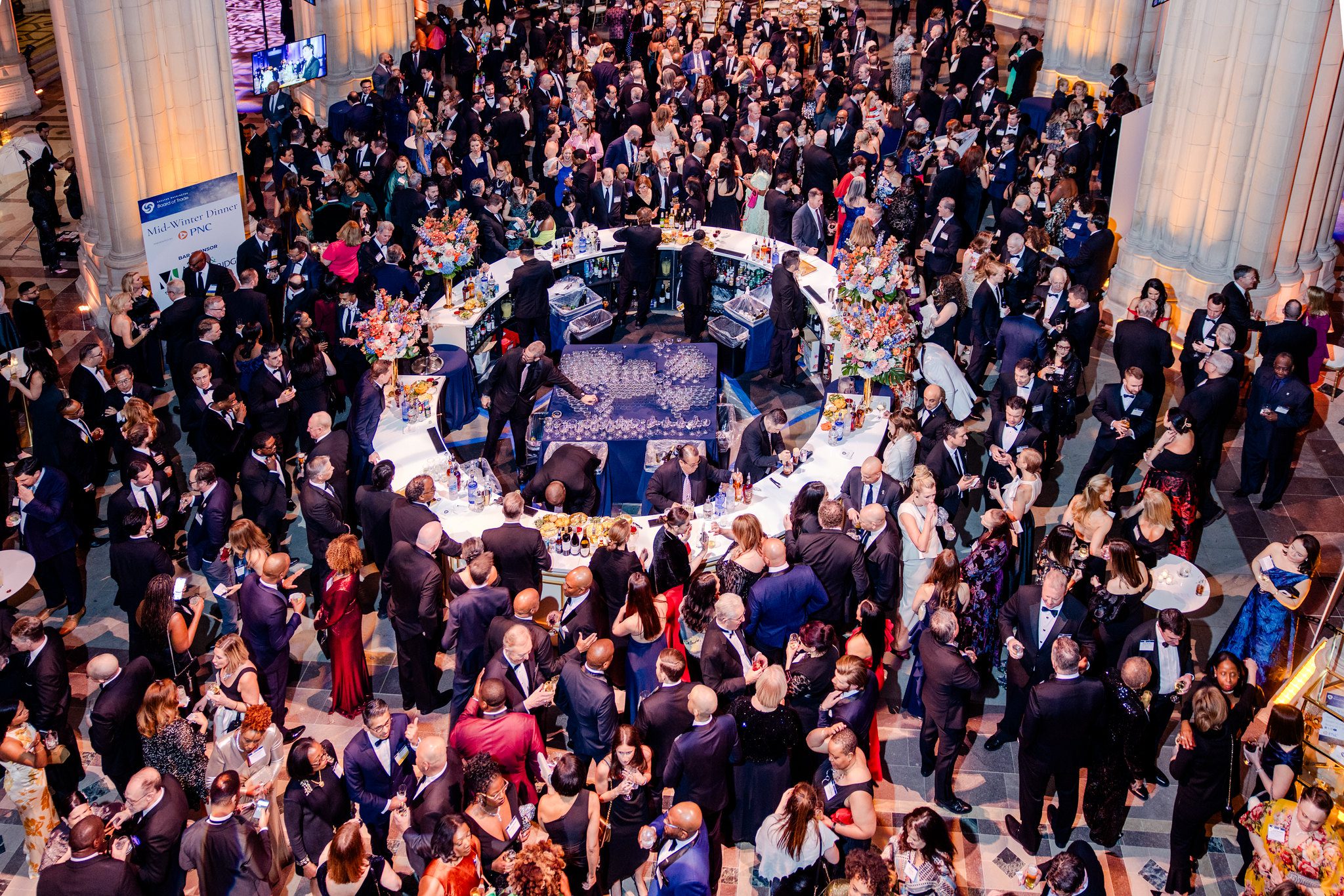
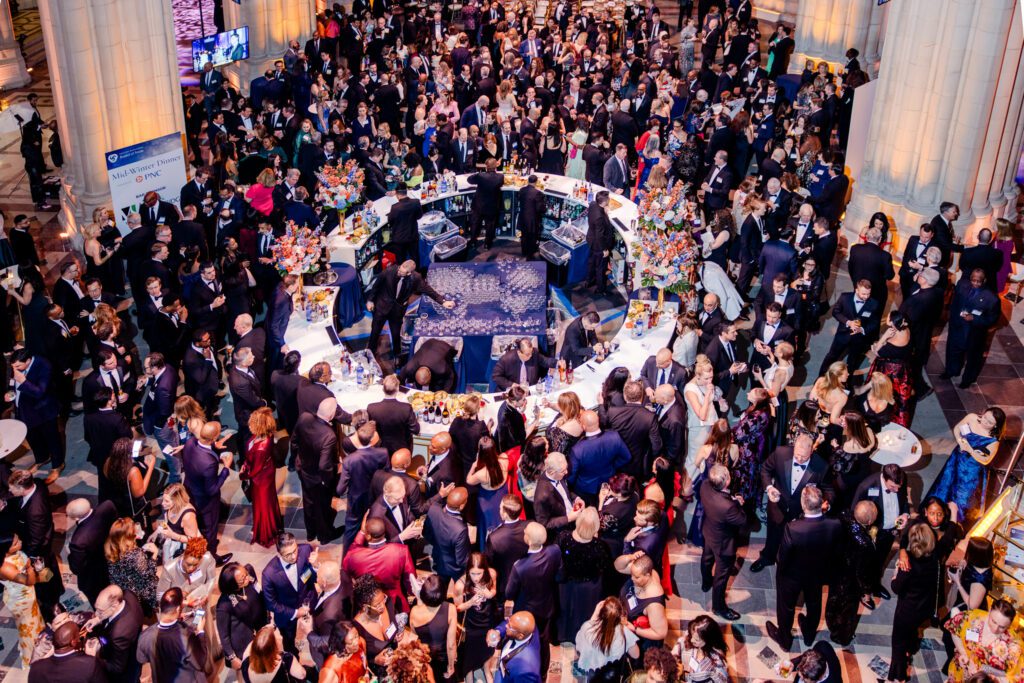
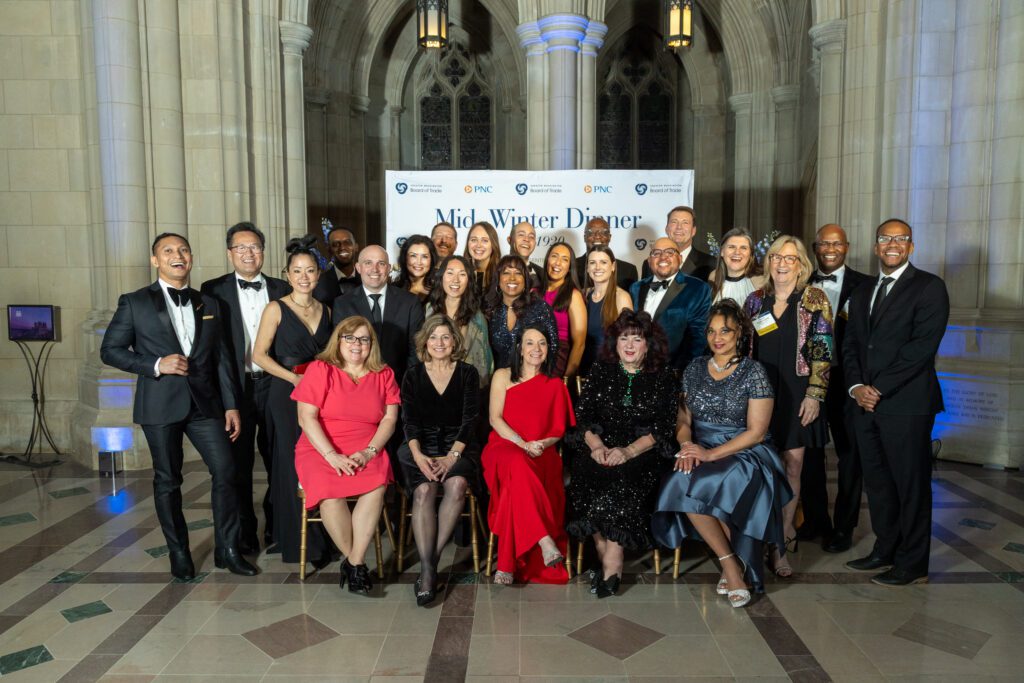
  • Delivered a robust slate of over 120 programs, events, and gatherings—including the Mid-Winter Dinner, Fall Business Classic, Annual Meeting, and TD Bank Morning Star Series—alongside executive roundtables, policy engagements, themed salons, and professional forums.
  • Programming aligned leaders around key regional priorities: economic competitiveness, transit funding, workforce pipelines, public safety, AI transformation, and more.
  • Reached 100% of the adjusted 2025 sponsorship forecast, ensuring delivery of high-quality programming amid shifting market and political conditions.
  • Positioned the Board of Trade as a trusted voice through op-eds in the Washington Business Journal, major partnerships with WTOP, and media coverage across Axios DC, FOX5, CBS/WUSA9, Washingtonian, and more.
  • Website enhancements drove a 46% increase in total users, 74% growth in direct traffic, and stronger inbound engagement from prospective members.
  • Established the Board of Trade Foundation governance structure and onboarded trustees.
  • Maintained a positive financial trajectory, improved AR, modernized IT systems, and reduced bank fees by 50%.

2025 New Members

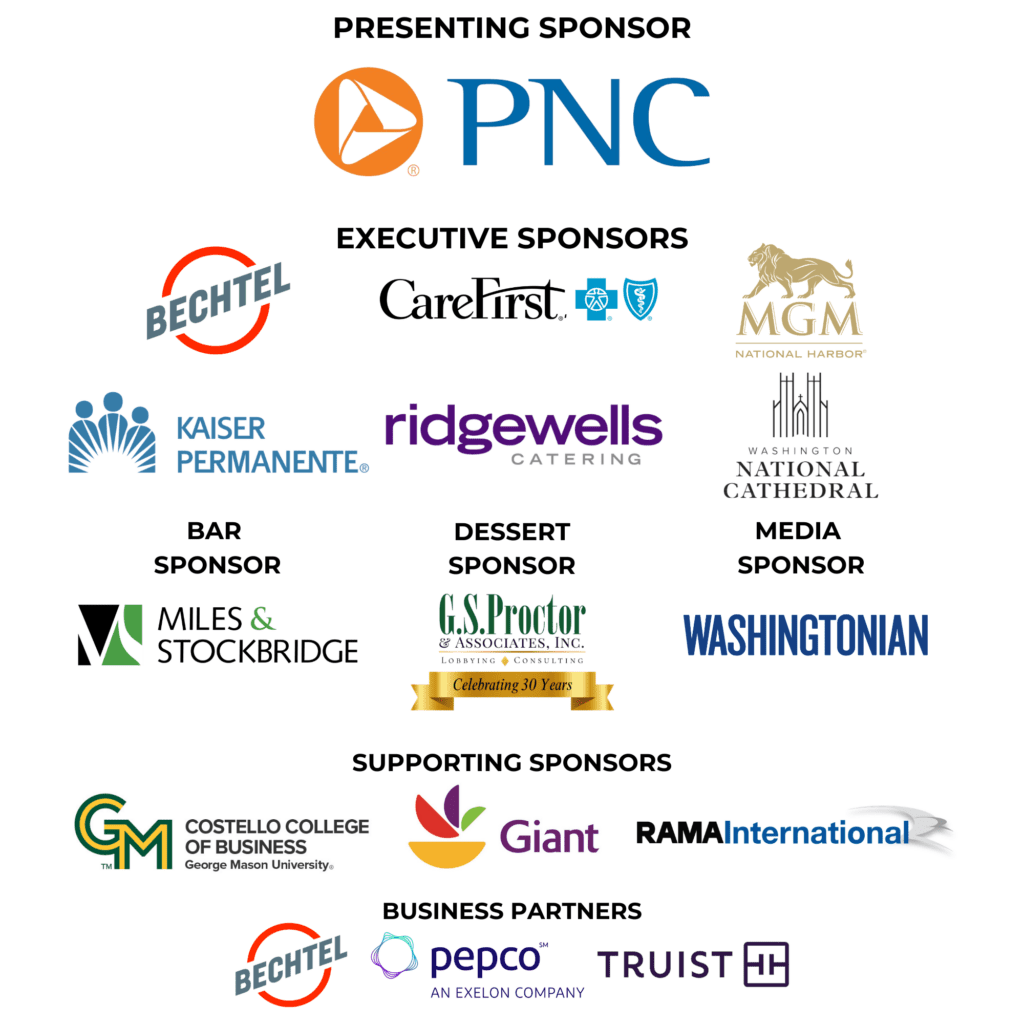
2025 Sponsors

LOOKING AHEAD TO 2026

As we carry the momentum of 2025 into the year ahead, the Board of Trade remains focused on strengthening the critical business infrastructure our region depends on and modernizing the regional economy. In 2026, that means putting more weight behind solutioning and strategy in areas such as securing dedicated funding for Metro, addressing energy and technology policy challenges, and advancing the capital, investment, and business conditions that allow employers to innovate, grow, and stay rooted here.

This work is only possible in true partnership with you. Membership is a platform, not a product; its value comes from how actively it is used. Being in the room is step one. We call you to lean in further, by lending expertise and talent, sharing data and examples from your organizations, and investing in the initiatives and discussions that move the needle.

To stay engaged in this consequential moment, we encourage you to connect with our team about where your organization can lead or contribute, participate in the strategy conversations most relevant to your priorities, and explore opportunities to collaborate.

As we look to 2026, we know the path won’t be simple, but it is full of opportunity. And as we have for more than 136 years, the Board of Trade stands ready to lead with purpose, partnership, and optimism for the future of Greater Washington.

Welcome 2026 Board Officers

Board members contribute to the Board of Trade’s success in several ways: they weigh in on strategic decisions; assist with the recruitment, retention, and onboarding process of members; lend resources and make connections to bring projects closer to their goals; and attend and support board meetings and other Board of Trade events throughout the year.

Join Us!

To get involved, connect with our team to explore ways to engage your entire organization. Follow our work—subscribe to our newsletters, connect on XLinkedIn & YouTube, and visit our newly revitalized website for insights, initiatives, and member highlights. Our events have seen unprecedented demand this year—selling out repeatedly—so be sure to secure your spot early and join these powerful conversations and engagements.

Not yet a member? Please consider joining us! As a member, as partners for change, or both, the Board of Trade is open for business and eager to team with any organization committed to our common goal of a Greater Washington region.


Connection Through Innovation: Highlights from the 2025 Capital Region Transportation Forum

How can the Capital Region build a transportation system that keeps pace with growth and innovation? That was the central question we aimed to answer at the 2025 Capital Region Transportation Forum, hosted by the Greater Washington Partnership and the Greater Washington Board of Trade. Held on December 2nd at George Washington University’s Jack Morton Auditorium in Washington, DC, the 8th annual forum brought together regional leaders and transportation stakeholders from across DC, Maryland, and Virginia. Attendees examined the region’s most pressing transportation challenges—from funding and governance to emerging technologies and data-driven planning—while exploring strategies to create a more connected, efficient, and forward-looking system. 

A Closer Look at the State of Metro 

Randy Clarke, WMATA’s General Manager and CEO, opened the forum with a State of Metro address highlighting both the system’s recent progress and the work still ahead to modernize and stabilize operations. He pointed to significant improvements in reliability, ridership, and safety, advancements that helped Metro earn recognition as the nation’s top transit system and achieve a 60% boost in reliability since 2022. Clarke also underscored the agency’s looming capital funding challenges, stressing the need for a sustainable, predictable regional funding solution to maintain this momentum and support Metro’s essential role in workforce mobility and economic growth. Looking forward, he outlined a vision for a modern, dependable transit network built on long-term investment, regional alignment, and a shared commitment to delivering a world-class transit experience. 

DMVMoves: From Strategy to Action

A panel discussion on DMVMoves explored the region’s ongoing efforts to align governance, secure sustainable funding, and strengthen transit operations across jurisdictions. Moderated by Jack McDougle, President and CEO of the Greater Washington Board of Trade, the conversation featured Fairfax County Executive Bryan Hill and Capitol Transportation Consulting Principal and DMVMoves facilitator, Nick Donohue. 

The panelists highlighted the progress DMVMoves has made over the past year, culminating in a proposal for $460 million in new annual capital funding for Metro beginning in FY28, and underscored Metro’s criticality to residents, employers, and our greater region. They emphasized that addressing the region’s transportation challenges will require sustained, long-term collaboration that extends beyond the conclusion of the DMVMoves initiative. 

trans25-359

Designing a Future-Ready Mobility Network

The forum concluded with a forward-looking conversation on how technology, data, and evolving innovation are reshaping the future of transportation. Moderated by Patrick McKenna, President and CEO of the Eno Center for Transportation, the panel brought together Laura Schewel from StreetLight Data and Matthew Walsh from Waymo.  

Panelists shared insights on how real-time data, autonomous vehicles, and public-private partnerships, such as Transurban’s new 495 Express Lanes, can support smarter planning, more efficient use of resources, and better outcomes for commuters and communities alike. The discussion emphasized that the future of mobility depends not only on technology, but also on leadership that is willing and able to adapt to policies and investment strategies to match and enable innovation.  

From transit reliability and funding to advanced mobility solutions, the path forward for the region’s transportation systems requires regional coordination, sustainable investment, and bold leadership. 

The Greater Washington Partnership and the Greater Washington Board of Trade thank our speakers, partners, and participants for contributing to a dynamic and solution-driven conversation. Together, we are working to shape a transportation system that supports a stronger, more connected Capital Region.  

Watch the 2025 Capital Region Transportation Forum


Special Thank You to Our Sponsors

Building One Regional Voice: Highlights from the 2025 Annual Meeting

Key takeaways on competitiveness, collaboration, and regional readiness as leaders across Greater Washington join the Board of Trade for its 136th Annual Meeting. 

The Greater Washington Board of Trade brought together more than 400 leaders from across business, government, higher education, and the nonprofit sector for the 136th Annual Meeting, presented by Kaiser Permanente. Attendees left with one clear message: Greater Washington is entering a defining era—one where collaboration, shared purpose, and a unified regional voice will determine our competitiveness for decades to come. 

The program opened with Emily Holliman, Interim Regional President and COO for Kaiser Permanente of the Mid-Atlantic States, who underscored the vital relationship between community health, economic strength, and workforce well-being. She spoke to Kaiser Permanente’s dedication to cultivating thriving communities—reinforcing why the organization has proudly served as the presenting sponsor of the Annual Meeting for 11 consecutive years. 

A Region at an Inflection Point 

Board of Trade President & CEO Jack McDougle delivered a candid and inspiring assessment of the past year—describing 2025 as consequential for the organization and the region. 

Greater Washington is experiencing profound shifts: 

  • The federal government is transforming how it operates, hires, invests, and uses physical space. 
  • AI, automation, electrification, and digital infrastructure are accelerating competitive pressures. 
  • Jurisdictions face resource constraints and competing priorities that require new levels of boldness and collaboration. 

McDougle emphasized that the pace of change won’t slow down—and we cannot afford to either. To meet this moment, regional leaders must move faster, think bigger, and work together more intentionally. 

Take a look at more photos from our Annual Meeting!

Regional Collaboration: From Aspiration to Reality 

A central theme echoed throughout the meeting: the future of Greater Washington depends on a new kind of regional collaboration—one that is durable, consistent, and grounded in shared priorities. 

McDougle highlighted several examples where this collaborative approach is taking hold: 

DMVMoves & the Future of Transit 

  • Metro was recognized as APTA’s 2025 Transit Agency of the Year, reflecting major progress in safety, reliability, and modernization. 
  • Through DMVMoves, leaders across D.C., Maryland, Virginia, WMATA, COG, business, and labor united behind recommendations for dedicated capital funding and a more integrated regional bus network. 

The DMV Monitor: A Shared Data Backbone 

  • In partnership with Brookings and COG, the Board of Trade helped shape the new DMV Monitor, providing a unified, regionwide framework for tracking economic and quality-of-place indicators. 

Talent Capital AI & Workforce Transition 

  • Working with the Consortium of Universities, COG, and D.C.’s education leaders, the region launched Talent Capital AI to support federal workers impacted by shifting workforce needs and technological change. 

The Potomac Conference: Building a Regional Formula 

  • The Board of Trade, Greater Washington Partnership, COG, and the Consortium of Universities are working together to create a shared structure for regional action on mobility, energy, competitiveness, talent, and governance. 

These efforts reflect a powerful shift—from fragmented decision-making to collective regional problem-solving. 

Toward a Unified Regional Voice 

One of the most resonant messages of the morning centered on identity:
Greater Washington lacks a common narrative and shared language about who we are—and who we aspire to be. 

For months, the Board of Trade has been working with APCO and member leaders to begin shaping a foundational story of the region. Attendees previewed early concepts that explore what defines the DMV and what truly differentiates us on a national and global stage. 

This work is at its beginning, but the goal is clear:
to build a unified, compelling regional voice that aligns leaders, strengthens competitiveness, and reflects the dynamism of our collective future. 

Learn More & Register for Our Next Signature Event

Keynote: How Purposeful Leaders Defy Drift 

Keynote speaker Steve Goldbach, Principal and Sustainability Leader at Deloitte US, delivered a timely message from his book Hone: How Purposeful Leaders Defy Drift. He urged leaders to avoid “wait-and-see” decision-making—arguing that in times of rapid change, the status quo is often the riskiest strategy. 

Goldbach encouraged the region to embrace continuous honing—small, purposeful adjustments that realign systems and structures with the future we want to build. His insights reinforced the regional themes of adaptability, shared responsibility, and stepping boldly into change. 

Learn more about our Keynote Speaker here

Celebrating a High-Impact Year 

Outgoing Board Chair Jeremy Blank of Deloitte highlighted major achievements that reflect the Board of Trade’s growing reach and energy: 

Membership & Engagement 

  • 95% of member companies engaged in programs and events 
  • 91% projected retention—well above association norms 
  • 29 new member organizations joining in 2025 

Thought Leadership & Visibility 

  • 12 million impressions through the WTOP “Regional Business Insights” series
  • High-impact placements across regional media outlets
  • Consistent presence on stages and at tables where the future of the region is being shaped

Blank emphasized that the Board of Trade is not a passive membership—it is an active platform. “Membership is like a gym,” he said. “You get out what you put into it.” 

New Leadership, Shared Momentum 

Incoming Chair Tyler Anthony of Pepco Holdings accepted the gavel, expressing his commitment to continuing the region’s positive momentum. 

Anthony highlighted three imperatives for 2026: 

  • Deepening regional collaboration across sectors 
  • Championing the big issues—transit, talent, economy, and infrastructure 
  • Strengthening the collective regional voice 

He encouraged organizations to continue sending their best people into this work, treating the Board of Trade as a regional team, not a collection of individual institutions. 

Looking Ahead: A Region Ready to Move Together 

This year’s Annual Meeting showcased something powerful:
Greater Washington is not waiting for perfect clarity. It is choosing to act—together, with purpose, and with a growing sense of shared identity. 

As the region undergoes generational transformation, the Board of Trade will continue to convene the people, data, partnerships, and strategic insight needed to move in one direction as one regional voice.  

Thank you to everyone who joined us. Together, we are building a Greater Washington that is bold, collaborative, unified—and ready for the future. 


Thank you to our sponsors for their continued support 

Voices from the Table: October Insights

When leaders across the Capital Region gather around a table, talk turns quickly from problems to progress. October’s conversations were about how to keep this region competitive and what it will take to move faster, smarter, and together. 
Why it matters 

The Capital Region has the assets to lead – world-class talent, location, and innovation capacity. But growth is uneven; infrastructure is aging; and coordination is hard. Leaders agreed: progress depends on connection – with each other, across sectors, jurisdictions, and priorities. 

What we heard 

Energy is a business issue now.
Leaders warned that the region’s energy and digital systems aren’t keeping pace with demand from data centers, EVs, and electrified transit. Reliability, modernization, and investment coordination will define competitiveness more than incentives alone. 

Mobility drives momentum.
With our region now the nation’s most congested metro, transportation has become the clearest constraint and opportunity. Executives called for bold P3 models, smarter design, and regional planning that moves people, goods, and ideas more efficiently. Connectivity isn’t just infrastructure; it’s economic oxygen. 

Purpose is part of performance.
Corporate–nonprofit partnerships are shifting. Companies are building trust through measurable, community-anchored impact aligning social investment with workforce stability, inclusion, and regional resilience. 

The big picture 

Across energy, transit, and social investment, the message was consistent: the Capital Region doesn’t need perfect regionalism; it needs practical alignment. Businesses can’t fix every policy challenge, but they can model collaboration, accountability, and long-term investment in the systems that sustain growth. 

Leaders know politics are tough and progress is incremental. But momentum builds when the right people stay at the table; aligning ambition with action, and vision with execution. 

Food for thought 

  • How do we modernize energy, transit, and digital systems fast enough to support growth sectors? 
  • What practical partnerships can turn fragmentation into a shared advantage? 
  • How can business leadership rebuild confidence that growth can be both competitive and inclusive? 

Bottom line: The Capital Region’s economy will grow when its leaders connect on purpose, with purpose. 

Executive Leadership Roundtable Recap: What Regional Leaders Are Watching

When conditions feel wobbly underfoot, the horizon matters most. Near-term signals can shake; what counts is the broader trajectory—and how leaders adapt. To compare notes on shifting conditions in the region, senior executives met on October 17 at Akin Gump Strauss Hauer & Field’s Washington, D.C., office for a candid Executive Leadership Roundtable with Tom Barkin, President & CEO of the Federal Reserve Bank of Richmond. The value came from leaders comparing notes in real time, connecting front-line experience with broader economic context.

Several recurring trends emerged

People & Demand

Hiring remains muted but stable—a low-hire/low-fire posture with attrition doing most of the work. Candidate availability has improved across many roles, but skilled trades, childcare, and eldercare remain tight. On the demand side, consumers are choosier and value-seeking, trading down (e.g., private label; repair vs. replace), with meaningful variability by sector.

Productivity & Operating Models

To protect margins, many firms are leaning into process redesign, automation, and practical AI—especially in support workflows (documentation, collections, customer contact). In practice, these moves often substitute for incremental hiring while leaders monitor service quality and outcomes.
Systems & Infrastructure

Capital planning assumes multiple interest-rate paths rather than a single trajectory. Supply chains continue to localize (“local-for-local”) where feasible as trade policy evolves. Meanwhile, accelerating demand from AI/data centers is colliding with long lead times for generation and transmission—raising near-term questions about power readiness. In commercial real estate, office softness (particularly B/C space in large cores) contrasts with relative strength in industrial, logistics, and data-center assets; the DMV feels the office adjustment more acutely than many markets.

Why it matters

The throughline wasn’t a single indicator; it was operating adaptation. Old playbooks map poorly to today’s pace and complexity. What’s working now: diversified talent strategies, productivity investments (including practical AI), financial flexibility, and regional alignment on housing and transportation to keep our talent advantage.

What leaders are watching next

  • Labor fit: Will skills pipelines (training, credentials, migration) keep pace with role requirements?
  • Cost pass-through vs. productivity: Can process/tech gains continue to offset input costs without eroding service?
  • Grid readiness: How quickly can generation/transmission investments meet data-center demand without bottlenecks?

The Board of Trade will continue convening executive-level dialogues that surface timely insights and connect them to practical action for our region.

​​Thank you to the Federal Reserve Bank of Richmond and Akin Gump Strauss Hauer & Field for partnering on this vital discussion that engages our members and partners in the region.

Coffee & Conversation Recap: Confronting Hunger and Economic Insecurity in Greater Washington

October’s Coffee & Conversation featured leaders from the Capital Area Food Bank (CAFB), who shared key findings from their 2025 Hunger Report – a sobering look at how economic pressures, wage stagnation, and federal workforce transitions are shaping food insecurity across the region. 

According to CAFB’s research with NORC at the University of Chicago, 36% of households in the DMV are food insecure, a rate that has remained elevated for two consecutive years. County rates range from 22% in Arlington to 49% in Prince George’s County, underscoring how widespread and persistent this challenge has become. The report points to deepening strain on working families as inflation outpaces wages and pandemic-era support expires. 

“We see families borrowing against their futures to meet today’s basic needs,” said CAFB President & CEO Radha Muthiah. “People are skipping savings, taking on credit-card debt, and even withdrawing from retirement accounts just to put food on the table.” 

Many food-insecure households include employed adults – teachers, healthcare workers, and public servants – earning too little to meet the region’s $140,000 living-wage threshold for a family of four. The conversation highlighted that solving hunger isn’t simply about distributing more food – it’s about strengthening the systems that enable financial stability. 

CAFB leaders shared examples of innovative partnerships that bundle food assistance with healthcare and workforce training, including Food Is Medicine programs with area hospitals and grocery-card stipends for college students pursuing credentials in high-demand fields. These integrated approaches aim to improve both individual well-being and regional productivity. 

Board of Trade President & CEO Jack McDougle closed by underscoring the economic stakes: 

“Food insecurity isn’t just a social issue; it’s an economic one. If we want Greater Washington to reach its full potential, we need to connect more people to opportunity and stability.” 


What the Business Community Can Do 

The conversation turned to practical steps the private sector can take to help reverse these trends: 

  • Advocate and support efforts that protect access to nutrition and healthcare programs like SNAP and school meals, which help working families stay afloat. 
  • Promote “Food Is Medicine” partnerships by engaging with healthcare systems and nonprofits to strengthen community health and workforce resilience. 
  • Invest in upskilling and talent pathways—collaborate with colleges and training providers to recruit, mentor, and support individuals moving into living-wage careers. 

By working together across sectors, employers can help address the root causes of hunger while building a healthier, more productive regional economy. 

Read the full 2025 Hunger Report: Capital Area Food Bank Hunger Report 2025 

About Coffee & Conversation

Coffee & Conversation brings Board of Trade members together for interactive, member-led discussions on timely topics shaping Greater Washington. Each session features a concise expert briefing, open dialogue, and time for coffee and networking – offering valuable insights, peer exchange, and meaningful professional connections.

Visit boardoftrade.org/events for more programming.

​​Thank you to the Capital Area Food Bank for partnering on this vital discussion that engages our members and partners in the region.

GWBOT October 2025 Newsletter

The Board of Trade remains focused on advancing the priorities that matter most to Greater Washington. This October newsletter shows a variety of engagements we have had across Greater Washington with members and public officials, while also showcasing meaningful updates on priorities we are following in the region. We also have a variety of member news updates that showcase regional collaboration!

Read our October 2025 Newsletter here

Shaping the Future: Recap of the Fall 2025 Board of Directors Meeting

The Greater Washington Board of Trade’s Fall Board Meeting – generously hosted by board member Ian Jefferson and the team at McKinsey & Company – brought together leaders from across the region to focus on two priorities shaping Greater Washington’s future: delivering collaborative progress and shaping a stronger regional identity. 

Collaborative Progress in Action 

Energy in the room was high as members discussed how cross-sector collaboration is moving the region forward. 

Key highlights included: 

  • DMV Moves: advancing a dedicated funding strategy to ensure reliable, sustainable transit for the region. 
  • DMV Monitor: a newly launched regional platform that now provides a unified, trusted set of data across jurisdictions to guide policy and investment. 
  • Talent Capital: launching October 1, designed to make it easier for people in the National Capital Region to connect with jobs, training, coaching, events, and entrepreneurial resources – a platform built here, for this region, to support both workers and employers. 

Together, these initiatives reflect the power of aligned leadership and collective action to tackle complex challenges. 

Photo Sep 17 2025, 12 51 13 PM

Reimagining Our Regional Identity 

A second focus of the meeting was the region’s narrative – how we define Greater Washington and the impact that story has on our competitiveness. 

In partnership with APCO Worldwide – with special thanks to board member Evan Kraus and his talented team – board members took part in an interactive branding exercise building on this year’s conversations about positioning Greater Washington as more than a government town: a place where talent, culture, innovation, and opportunity converge. 

While participants explored ideas like Capitalize Your Future and Move With Us as ways to capture the region’s strengths, Jack McDougle emphasized that the real takeaway isn’t about picking a slogan – it’s about leaders across sectors speaking with a united, confident voice about Greater Washington so that, over time, this shared narrative strengthens our identity and attracts more talent, investment, and innovation. 

Looking Ahead 

The meeting closed with a shared understanding: building a stronger regional identity takes time, resources, and collective leadership – but it’s already underway.

From funding transit and unifying data to shaping the narrative that defines Greater Washington, the Board of Trade will continue to convene, lead, advocate, and innovate to keep the region competitive. 

Together, we are laying the groundwork for Greater Washington to be recognized not only as the nation’s capital but as a region of opportunity – where talent, culture, and innovation drive long-term growth. 

Unlocking Connection Through Storytelling: Leadership Lessons from the O Museum

As today’s leaders navigate increasingly complex environments, the 2025 TD Bank Morning Star Speaker Series reminds us that leadership growth is strengthened through the stories we tell, the challenges we share, and the connections we build.

On September 24th in Washington, D.C., the Board of Trade, in partnership with TD Bank and the O Street Museum (O Museum), hosted the final session of this year’s series: The Power of Storytelling in Leadership. Surrounded by hidden doors and eclectic artifacts, attendees explored how storytelling can turn everyday interactions into meaningful experiences.

Change, Connection, and the Stories Between

The conversation wove together insights from H. Leonards, founder of the O Museum, and David Hargadon of TD Bank. Leonards reminded guests that creativity, curiosity, and imagination create space for growth and “real change comes from changing one heart at a time.” Hargadon built on this message, sharing how storytelling can strengthen relationships and leadership presence. Networking, he emphasized, isn’t about exchanging cards but about sharing short, memorable moments that reveal values, build trust, and humanize leadership.

Those ideas came to life as participants set out on a scavenger hunt through the museum, using artifacts as prompts for conversation. A vintage guitar might spark a story about teamwork; a hidden door could inspire reflection on navigating change. What could have been ordinary networking quickly became an exercise in discovery, showing how curiosity and shared experience can turn small interactions into genuine connection.

TD092425-223

Lessons That Last

The morning’s conversations left participants with reminders to carry forward:

  • Connection matters: Memorable anecdotes make conversations more impactful.
  • Identity is built through story: Consistent messages reinforce both personal and organizational brands.
  • Resilience inspires: Sharing challenges demonstrates courage and motivates others.

Celebrating the 2025 Series

This session concluded the 2025 TD Bank Morning Star Speaker Series, which over three installments focused on emotional intelligence, collaboration, and storytelling. Across the year, participants gained practical tools, shared experiences, and meaningful dialogue that turned leadership concepts into human connection.

As the Board of Trade looks ahead, that spirit will continue, creating opportunities for Greater Washington leaders to grow and lead in ways that are, in the words of TD Bank, unexpectedly human.

Special Thanks

The Greater Washington Board of Trade extends its thanks to TD Bank for 18 years of partnership in fostering unexpectedly human leadership experiences, and to the O Museum for hosting this imaginative and engaging session.

Founder of the O Museum and beloved figure in Washington, H. Leonards has devoted her life to building spaces that spark curiosity, creativity, and social change. She is also the visionary behind 51 Steps to Freedom®, an app and living trail that turns D.C. into the largest outdoor museum, bringing history to life for a new generation.

Featured Members