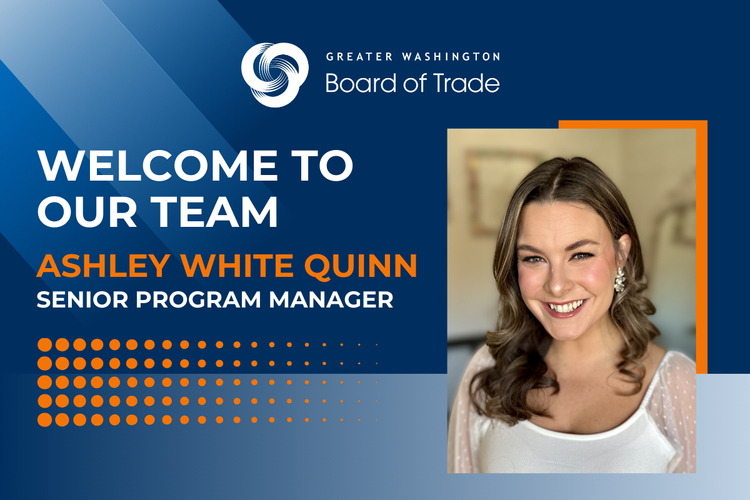
Ashley White “AW” Quinn was recently named the Senior Program Manager at the Greater Washington Board of Trade to continue our organization’s need to serve our members in a quick-moving, always-evolving business environment.
AW graduated from Grove City College in western Pennsylvania, where she completed her bachelor’s degree in communication studies. She has since honed her skills in event management, working in the nonprofit sector and the financial district in D.C. Most recently, she served as Events Manager for the Loudoun County Chamber of Commerce, where she planned 100+ high-quality and consistently profitable programs, meetings, and special events ranging from networking socials to industry-specific events to 500+ person galas each year.
AW hopes to bring the same passion for thought leadership, member engagement, and community vitality to her new role with GWBOT. Although a Nashville, TN native, she has called the DMV area home for over eight years and currently lives in Leesburg, VA.
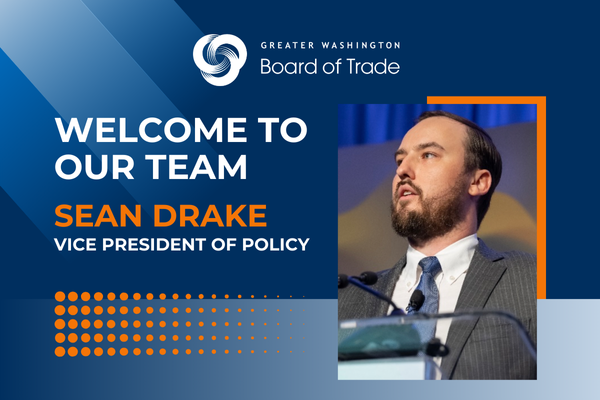
Sean Drake was recently named Vice President for Policy at the Greater Washington Board of Trade to continue our organization’s efforts to positively impact our members and the region’s business community.
With over a decade of government affairs and policy experience, Sean previously worked as Director of Government Affairs and Advocacy for the International Hearing Society. In this role, he led all government affairs, advocacy, payer advocacy, and policy efforts for the association in the wake of the FDA’s over-the-counter hearing aid policy, which succeeded in expanding access to critical healthcare services for veterans at VA medical centers, including issues related to Medicare and Medicaid Policies.
Sean’s additional professional experience has also allowed him to engage in policy efforts at the city, state, and federal levels, which will be invaluable to the Board of Trade as we push forward on our organization’s goals and initiatives.
Sean’s hiring further expands the work of our growing policy department at the Board of Trade after our organization recently hired Shayla Moon as our Senior Vice President of Policy to lead the department.
Sean is originally from Sarasota, Florida, and is a proud graduate of Florida State University, where he completed his bachelor’s degree in political science and international affairs. He also has a Master’s in Public Administration from Penn State University.
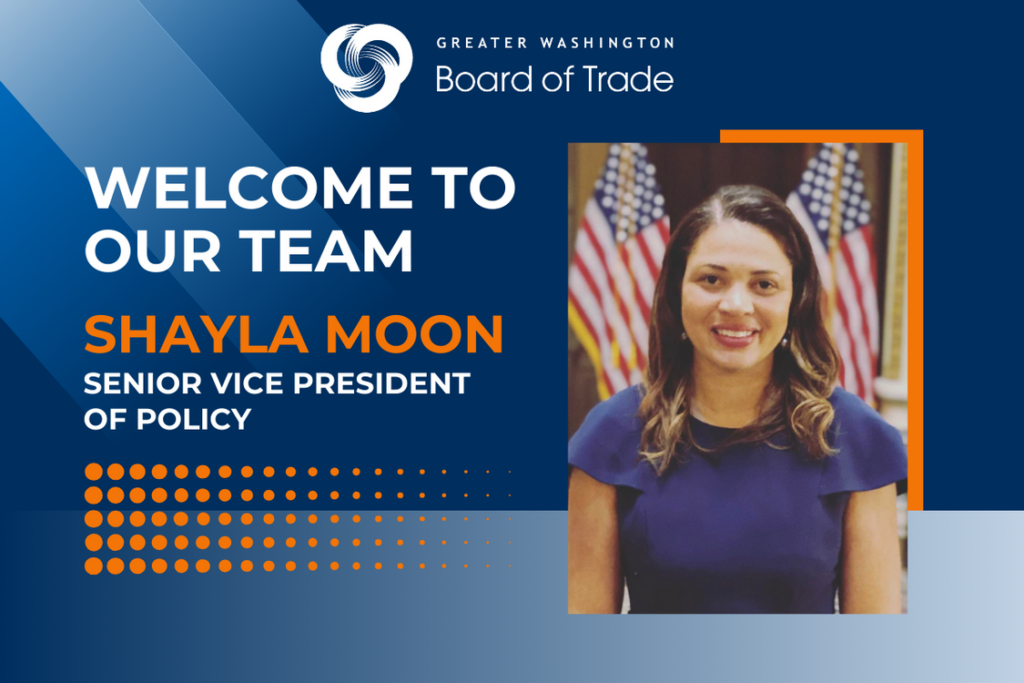
Shayla Moon was recently named Senior Vice President for Policy of the Greater Washington Board of Trade to continue our organization’s efforts to engage regional leaders regarding policies and legislation that impact our members and the region’s business community.
Shayla brings an extensive background in public policy, having served in various roles, including Senior Director of Economic and Housing Policy for the National Urban League, Senior Legislative Affairs Specialist for the Department of Commerce, and several trade associations and nonprofit organizations. Her public policy career has included efforts in New Orleans following Hurricane Katrina with City Year Inc., issue advocacy on Nuclear Arms Reduction (New START Treaty), ratification of the U.N. CEDAW Treaty, as well as content theft and diversity policy for the Motion Picture Association of America/Creative Future.
Shayla is also an honorably discharged United States Air Force veteran who is actively involved with several civil rights and women’s organizations. She serves on the board of Friends of the Blair-Caldwell African American Research Library. In her free time, she enjoys spending time with her son and dog, gaming, skiing, collecting sneakers, and listening to classic jazz and hip-hop records.
The Board of Trade looks forward to the great work that lies ahead for Shayla and our policy department. And to continue the work we have done that creates value for our region’s business community and for our members.
Since 2022, Washington Gas has teamed up with WUSA9 for multiple Recycle Days. On March 9, our Springfield, Virginia location volunteers welcomed hundreds of vehicles to drop off items rerouted from landfills to recycling facilities. All that behind-the-scenes work resulted in 26 tons of old paper being reclaimed for a new future.
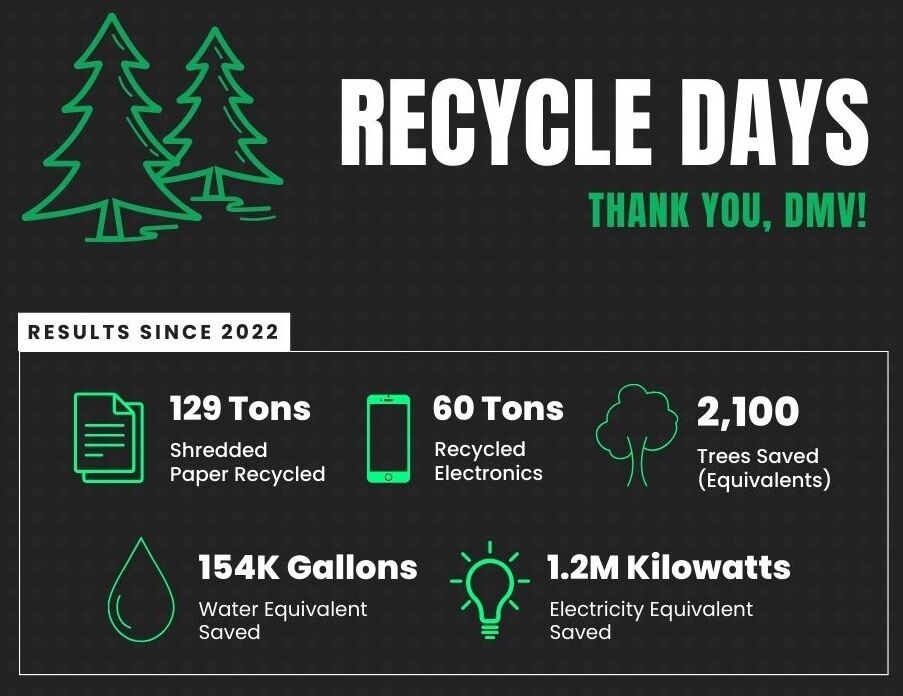
Want to see something even more inspiring? Check out the cumulative results from our five sponsored Recycle Days.
📝 Paper: 252,000 pounds (129 tons) With the average ream of copy paper containing 500 sheets, 129 tons of paper equals over 25 million pages. That’s enough to stack as high as about 20 Washington Monuments and enough square footage to paper more than 270 U.S. football fields.
🖥️ Electronics: 133,000 pounds (60 tons)
Electronic devices are especially problematic in landfills. Their glass alone can take 1-2 million years to decompose, so every reclaimed electronic is a win. Rescuing old items can also reduce the high-energy needs of raw mining and first-time refining. For example, steel is 100% recyclable and can be repeatedly reused at the same quality, while recycling aluminum uses 95% less energy than producing the metal from its original ore.
🌲Trees: 2,100 saved (equivalent)
When envisioning the 2,100 tree equivalents saved overall, picture preserving more than half of the 3,800 flowering cherry trees along the National Mall. Since trees love hydration, they’ll be extra happy to learn that the five combined Recycle Days have conserved more than 154,000 gallons of water.
We thank WUSA9 and everyone in the DMV for being outstanding partners in making small changes that led to staggering results. While we’re very proud of these initiatives, the planning and work toward our energy future are only getting started.
Trash & Trilemma
As we celebrate the immediate wins from Recycle Days, our world is also facing what is known as the Energy Trilemma. If you’re not familiar with this term, it refers to the challenge of balancing our energy systems to be reliable and affordable while supporting climate goals, now and in the future.
Reliability means ensuring that energy supplies are consistent and dependable to run homes, businesses and services without interruptions. In 2023, the Washington Gas reliability rate was 99.86%.
Truly affordable energy must be equally available and cost-effective for all. The American Gas Association (AGA) confirms that using natural gas has saved families $125 billion over 10 years.
Supporting climate goals includes making intelligent, innovative energy decisions that support lower-carbon solutions and long-term efficiency. For example, Washington Gas is making a strategic investment of $1.7 billion over the next five years in pipeline modernization.
From Recycle Days to modernizing our infrastructure, these interlocking steps can help resolve the Energy Trilemma. Our distribution networks enable us to deliver natural gas today and can also provide a foundation for delivering lower-carbon solutions in the years ahead. In the short run, we will primarily pursue energy efficiency and renewable natural gas (RNG) projects. These are ready-now technologies that we will continue to innovate into the future.
Recycling and RNG
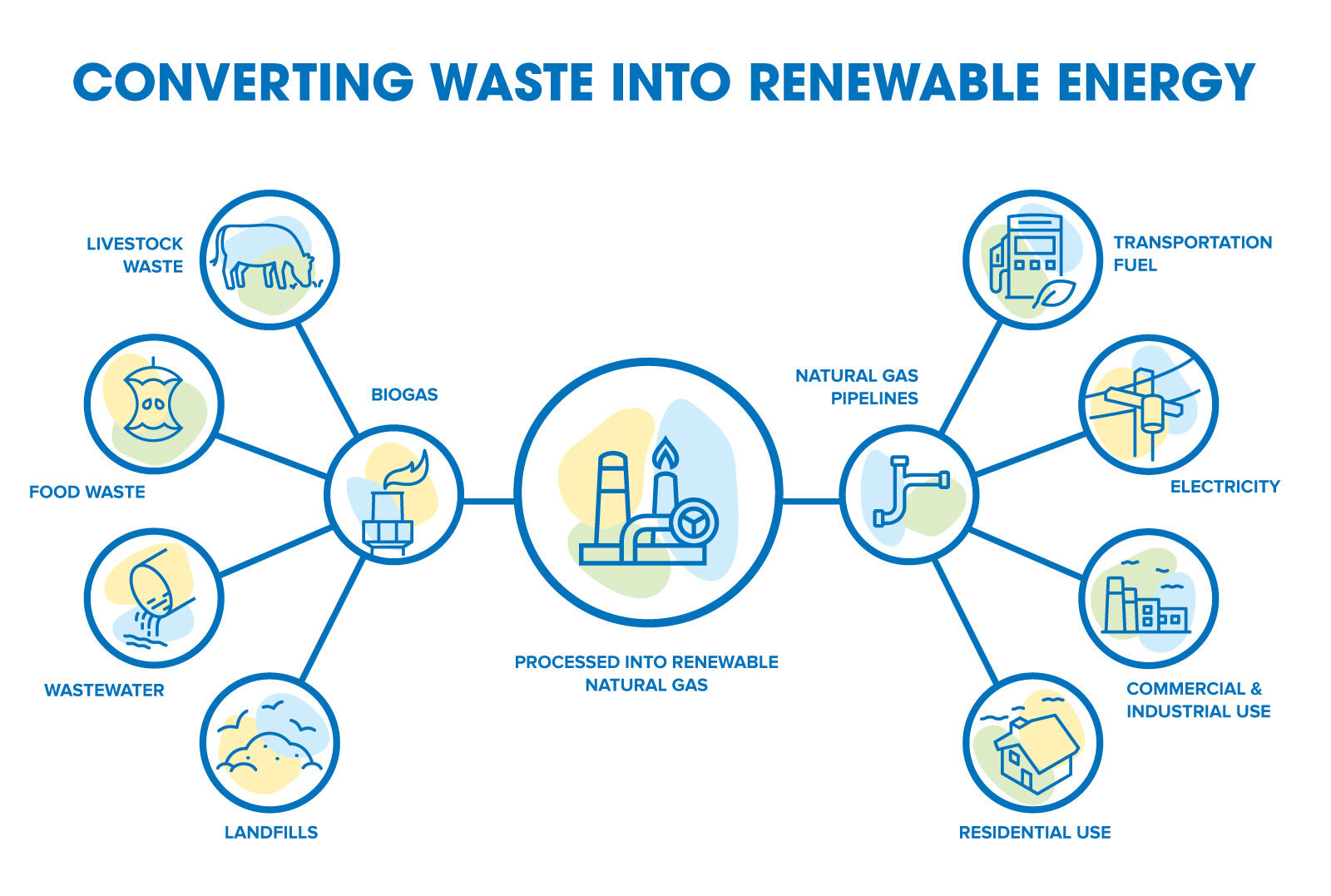
While they may seem unrelated, recycling events and RNG share a common thread: transforming waste into wins. Just as recycling helps keep trash out of landfills, RNG technology can convert organic landfill waste into lower-carbon fuel options.
Renewable natural gas can be an exciting, powerful strategy for managing municipal landfill methane emissions. Landfills produce methane because of significant accumulations of biostock: a mix of food and landscape waste, biosolids, manure, digestate, sludges and other organic materials. (Yummy.)
The U.S. Environmental Protection Agency estimates that, in 2019 alone, the food retail, food service and residential sectors generated 66 million tons of wasted food, with about 60% of this going to landfills. Municipal solid waste landfills, in 2021, generated about the same greenhouse gas emissions as 23.1 million gasoline-powered passenger vehicles driven for one year. Now for the good news. Specialized facilities can collect and process biostock to create concentrated methane gas (RNG). When injected into natural gas pipelines, RNG can provide a readily available renewable energy source. Washington Gas has partnered with various companies to support safe RNG integration into our existing natural gas distribution infrastructure. Strategically located across the DMV service territory, these resources will help ensure reliable, affordable energy while supporting long-term climate goals.
From recycling to RNG, Washington Gas is proud to be the DMV’s modern energy partner. We will soon share more about our plans, including the 2024 results update for our Accelerated Pipeline Replacement Programs.
Please stay tuned, and thank you for 175 years of support. We are honored to provide the safe, reliable energy that powers the DMV.
This is a sponsored piece of content from a member organization at the Board of Trade and does not reflect the views of every member in our organization.
For D.C. business travelers, United can help you save money and earn rewards
The nation’s capital plays a vital role in United’s network, which is now the largest and most diversified international route network among U.S. airlines. For business travelers in the Washington, D.C., area, we provide convenient access to major cities in the U.S. and beyond with daily nonstop flights from all three D.C. area airports.
Through United for Business, we cater to the needs of business travelers in D.C. and around the world. Whether you’re “flying solo” or work for a large corporation, there are many benefits available that can help make business travel more affordable, enjoyable and convenient.
Travel options for businesses of all sizes
Establishing a relationship with an airline for business travel can help you maximize your travel budget. If you work for a large employer, your company may already have a travel program in place with an airline to receive discounts and rewards.
If you work for a small to midsize company, or even if you own your own business, you might think you’re too small to partner with an airline – but that’s not the case. United can help even the smallest small businesses save on air travel. If your small to midsize company has employees who travel regularly for business, finding a travel solution can help you save money, earn rewards, and make travel easier and more convenient.
Savings
Savings and discounts are one of the main benefits of business travel programs, and these savings come in many different forms. Discounts are usually based on travel volume as well as the airline’s route structures.
With a travel program in place, you’ll get better rates that are negotiated based on sending the airline certain volumes. Most volume-dependent discounts range between 3 and 5 percent, but larger discounts may be available on higher-class tickets or when the airline wants to build volume on a particular route.
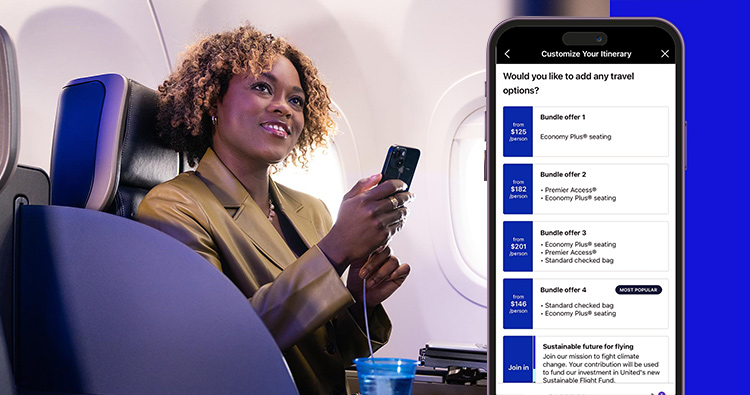
For small to midsize businesses, United for Business offers “off-the-shelf” travel plans based on your travel needs, whether you’re looking to save money, provide your travelers with amenities, or a combination of both.
Another way to save can be found in how you book travel. Booking directly with an airline can save you and your travelers money. When you book direct with United, either on united.com or the United app, you’ll have access to our lowest price points and your travelers will automatically receive your company’s negotiated discounts.
Rewards
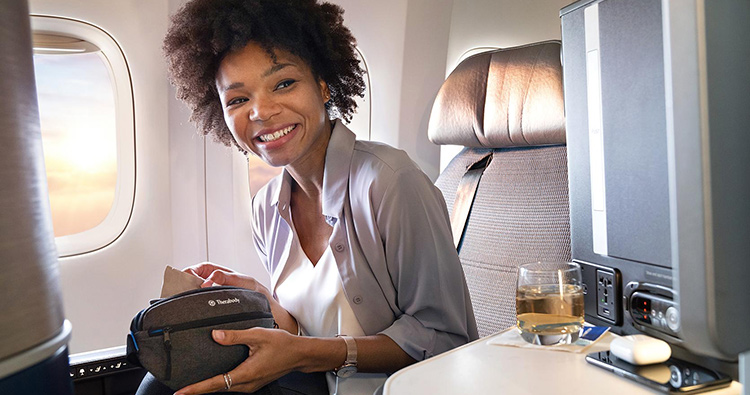
Partnering with an airline can also provide many rewards to enhance your travel experience – and not just for C-suite employees. For example, business travelers can earn discounts on amenities from airlines for perks like access to airport clubs and lounges.
Loyalty program benefits, like those available through United MileagePlus, are one of the most common ways to earn rewards.
It’s free for travelers to join MileagePlus® to start earning miles for travel. Miles can be earned and redeemed on flights with United and our airline partners. They can be used for upgrades like elite status matching, flight upgrades, lounge access, priority seating and preferred seating. And MileagePlus miles never expire.
Frequent travelers have the opportunity to earn MileagePlus Premier® status. They’ll enjoy benefits that elevate their travel experience like complimentary access to Economy Plus® and preferred seating, waived fees, upgrades, and priority travel services.
Convenience
Another benefit of having a relationship with an airline like United is convenience, from booking travel to landing at your destination. When you book travel direct on united.com or the United app, you’ll have access to conveniences such as assistance with rebooking options if your flight is canceled or delayed.
With the United app you can book travel, change seats, access your boarding pass, and use other features that make travel easier such as:
Bag drop shortcut – prepay and check in your bags with the app to skip the long line at the airport
Terminal guide – get step-by-step, personalized guidance to navigate the airport
Bag tracking – track your bags throughout your journey
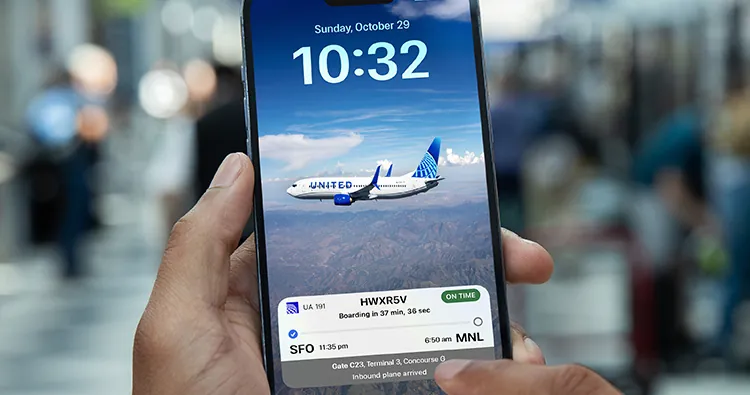
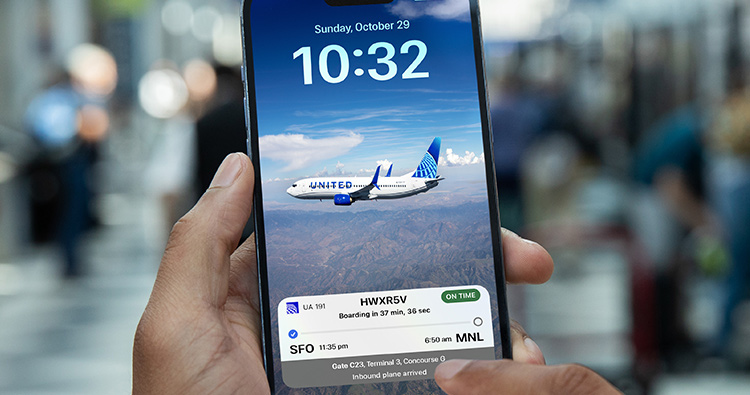
Live Activities – see real-time flight updates on your phone without unlocking it
If you manage travel for your small to midsize business, the United for Business travel management portal offers features that can make this responsibility easier. Through the portal, you can book travel for others, set policies like the maximum budget for a trip, manage form(s) of payment, track travel spend and more.
From D.C. to almost anywhere
“Connecting people. Uniting the world.”
It’s United’s purpose, and it’s what we do for travelers – with those in the D.C. area being no exception. With the largest global route network in the world, we offer business travelers seemingly limitless options for business travel, both domestically and internationally.
United serves travelers from all three D.C. area airports – Baltimore/Washington International Thurgood Marshall (BWI), Ronald Reagan Washington National (DCA) and our hub at Washington Dulles (IAD).
Baltimore/Washington International Thurgood Marshall Airport (BWI)
From Baltimore/Washington International we offer nonstop daily flights to five of our U.S. hubs:
BWI to Denver International – approximately twice daily
BWI to George Bush Intercontinental (Houston) – approximately three times daily
BWI to Los Angeles International – approximately once daily
BWI to Chicago O’Hare – approximately three times daily
BWI to San Francisco International – approximately once daily
Ronald Reagan Washington National Airport (DCA)
United serves Ronald Reagan Washington National with daily nonstop flights to five of our U.S. hubs:
DCA to Denver International – approximately once daily
DCA to New York/Newark – approximately 10 times daily
DCA to George Bush Houston Intercontinental – approximately six times daily
DCA to Chicago O’Hare – approximately 10 times daily
DCA to San Francisco International – approximately once daily
Our United Club at DCA is located at Terminal 2, across from Gate 11.
Washington Dulles International Airport (IAD)
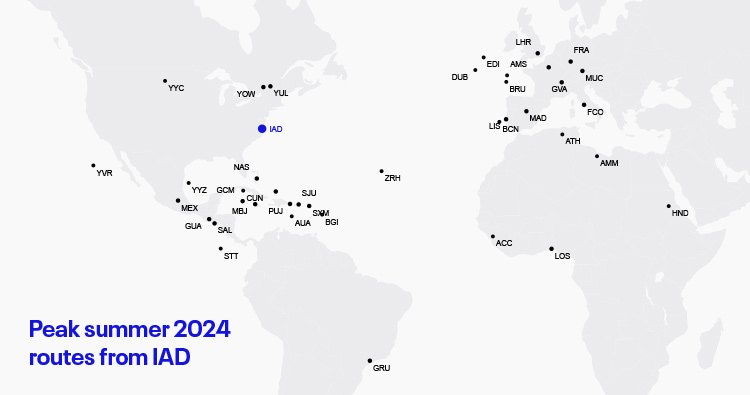
United is proud to call Washington Dulles International one of our seven U.S. hubs. We’re the D.C. metropolitan area’s largest airline with more than 215 daily flights, increasing to more than 250 daily flights in the summer.
From Dulles, we offer daily service to approximately 60 destinations in the U.S. and Canada. We serve nearly 40 international destinations from Dulles with either daily or weekly service, depending on the destination.
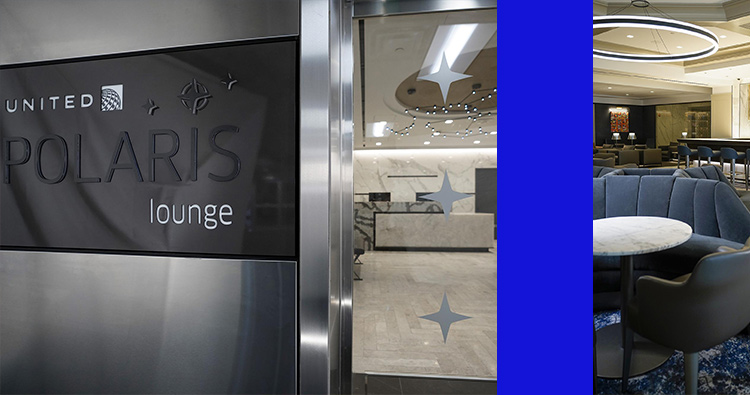
At Dulles, we offer four United Club locations and a United Polaris lounge (for eligible customers).
The largest airline network
If you’re traveling beyond the U.S., United now has the largest and most diversified international route network among U.S. airlines. We offer nonstop service to 134 international destinations across 67 countries with more flights to more destinations across the Atlantic and Pacific than all U.S. carriers combined.
Our network is further extended by our relationships with many other airlines around the world. We have alliances and strategic agreements with many of the world’s leading global airlines and travel companies to give travelers more options and help make world travel more accessible.
In addition, we’re a founding member of Star Alliance, the world’s largest airline alliance with destinations in nearly 200 countries. The alliance consists of 26 airlines, including Air Canada, All Nippon Airways, Austrian, Brussels Airlines, Lufthansa, SWISS and more.
You can usually book flights with Star Alliance airlines on united.com or the United app just as you would book United flights, if the flight is part of your United itinerary. Plus, you’ll earn miles and status when you fly with most of our airline partners, just as you would when you fly United.
Airline clubs and lounges
Many airlines have airport clubs and lounges for travelers to enjoy while waiting for their flight. United has an extensive network of clubs and lounges around the world including more than 45 United Club locations, six United Polaris® lounges, and select partner lounges worldwide.
There are a variety of ways you can get United Club access if you’re traveling United or one of our partner airlines – from buying a one-time pass to purchasing an annual membership. Business travelers may be able to earn discounts for amenities including access to clubs and lounges.
United Club locations provide space to work or relax before your flight. You’ll find a variety of seating options; complimentary snacks, beverages and bar service; and free Wi-Fi.
Long-haul international premium cabin travelers may have access to a United Polaris lounge. These lounges offer premium amenities such as spa-like showers and a private rest area with daybeds so customers can prepare for long flights. We have six United Polaris® lounges, including one at Washington Dulles with 21,000 square-feet of space.
In the D.C. area, travelers can enjoy these United Club locations:
Washington Dulles (IAD)
United Club, Midfield Terminal, Concourse C, near Gate C4
United Club, Midfield Terminal, Concourse C, near Gate C7
United Club, Midfield Terminal, Concourse D, near Gate D8
United Club, Midfield Terminal, Concourse C, near Gate C17
United Polaris lounge, Midfield Terminal, Concourse C, near Gate C17
Reagan National (DCA)
United Club, Terminal 2, across from Gate 11
Sidebar: Business travelers in the D.C. area are invited to learn more about the travel programs available through United for Business. To start exploring with no obligation, just enter your work email.
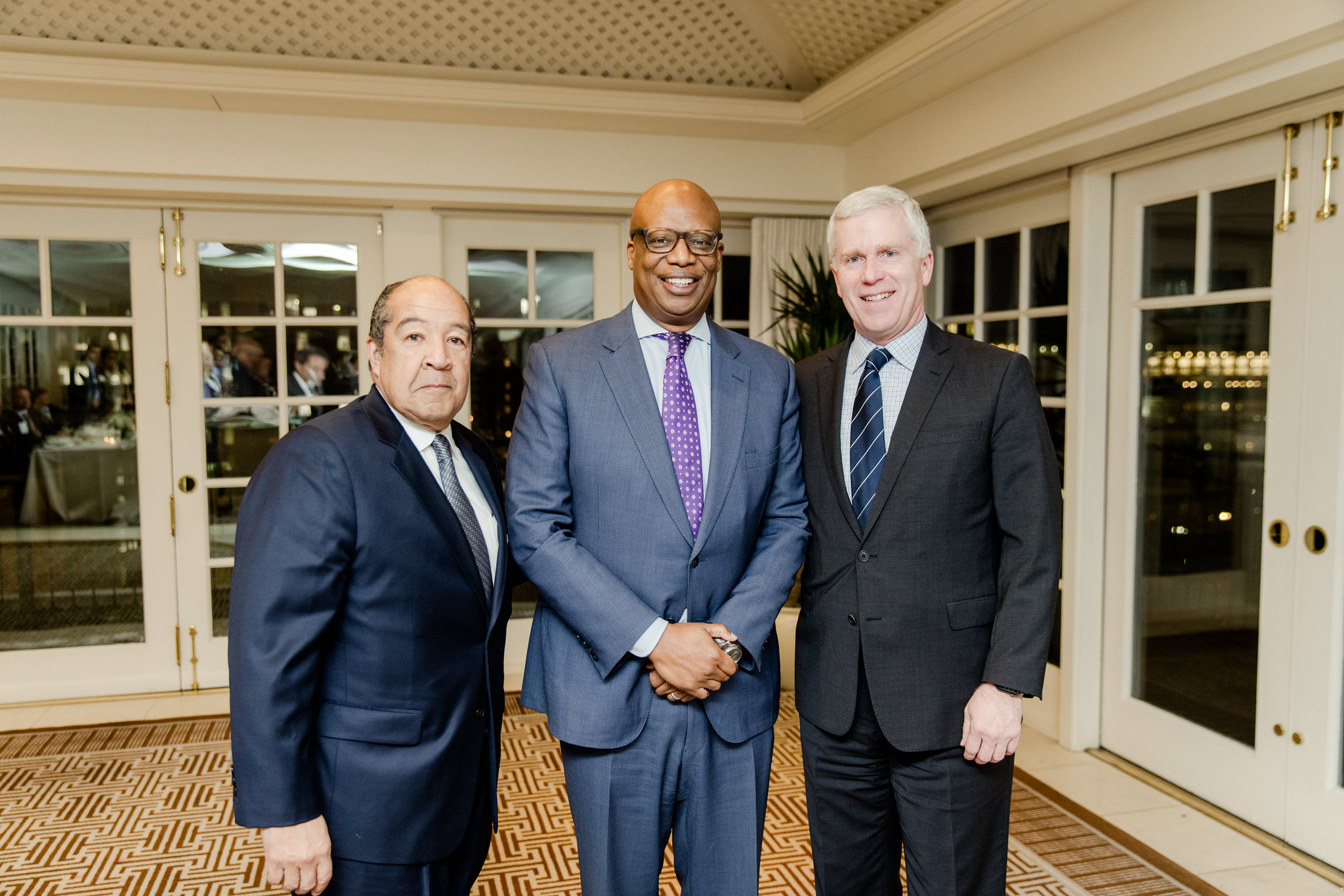
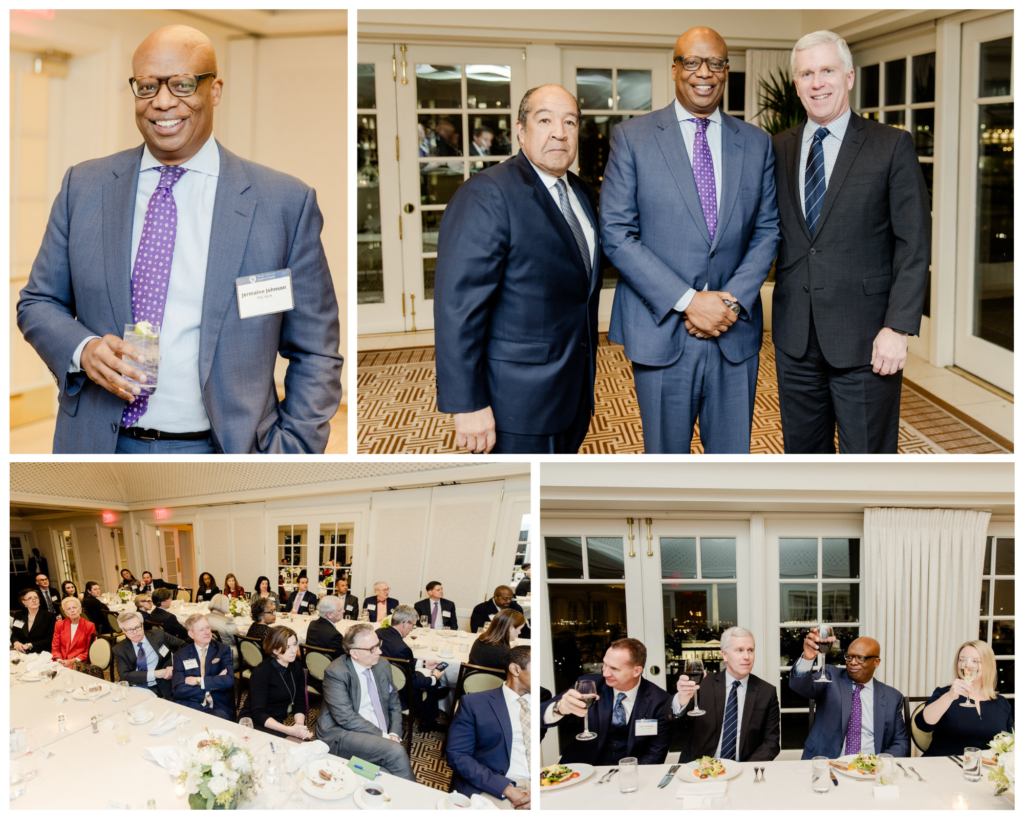
Each year, the Board of Trade celebrates our recent past-chair in an evening of reflection, stories, and laughter with board colleagues, coworkers, family, and friends. We had the pleasure of holding our Annual Chair’s Dinner honoring 2023 Board Chair Jermaine Johnson, Regional President, Greater Washington & Virginia at PNC, on Jan. 23 at the Hay Adams Hotel.
The intimate gathering provided a moment of reflection as we dive into 2024, offering heartfelt gratitude to Jermaine for his exceptional leadership, unwavering integrity, and tireless dedication to our organization. His invaluable contributions have been instrumental in achieving our goals and advancing the mission of supporting the region’s business community.
Board members Steve Proctor (2024 Board Chair), Tony Pierce, Tim Gillis, Courtney Spaeth, and our president Jack McDougle shared their personal experiences with Jermaine during his term as Chair and celebrated the ongoing work of the Board of Trade. Poised as a compassionate problem solver, Jermaine’s legacy will be stamped on the Board of Trade’s progress in addressing critical issues such as Metro funding, public safety, downtown revitalization, and overall regional growth.
“Jermaine has been a steady presence within our organization’s leadership for years and has served during some of the most challenging times we’ve faced as a region and business community,” said Jack McDougle. “I am very proud of this organization and where we are today. Thank you, Jermaine, for your leadership and your friendship. The Board of Trade is as strong now as it has been in decades.”
Tim Gillis highlighted Jermaine’s character as “So humble. So genuine. So real. So effective.” capturing in just a few thoughtful words Jermaine’s impact on the community.
Jermaine thanked his children and wife, Rae Ann, for joining this celebration and joked he wished his senior executive team had been in attendance to hear some of these accolades! He closed out the evening, sharing his pride in the organization and its role in our community, and promised continued commitment to building a better region for all.
“The Board of Trade has always been a conduit of institutions, and it has truly been an honor for me to serve as an officer of this organization for the last five years,” said Jermaine. “Our executive committee should be applauded for their work supporting all the great things we did in 2023.”
Jermaine, your exceptional leadership and genuine authenticity have made this past year remarkable. As you join the Board of Trade’s Senior Council, your wisdom and mentorship will continue to be invaluable. Your dedication, alongside that of our fellow board members, is instrumental in supporting the Greater Washington business community.
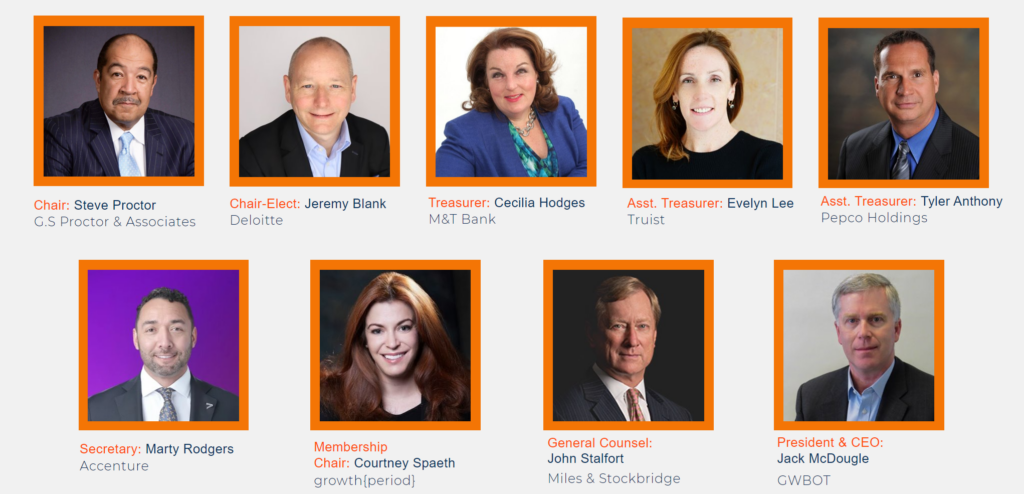
Meet our 2024 Board of Trade officers! At the forefront is Steve Proctor, President and CEO of G.S. Proctor & Associates, who steps into the role of 2024 Board Chair. Together with Steve, this dynamic leadership will continue to guide the Board of Trade as we navigate new intricate and rewarding challenges, promising higher impact and a strengthened network within our community. Embracing these hurdles with the same vigor that defines us, we’re geared up to tackle them head-on, leveraging our experiences and collective strength to make an even greater difference.
In 2023, we welcomed over 30 esteemed organizations, enriching our community and elevating the Board of Trade to new heights. As we anticipate the exciting opportunities of 2024, our existing members are integral to our success. If you know of an organization that should be part of this thriving community, take action! Reach out today to explore the benefits of joining the Board of Trade community.
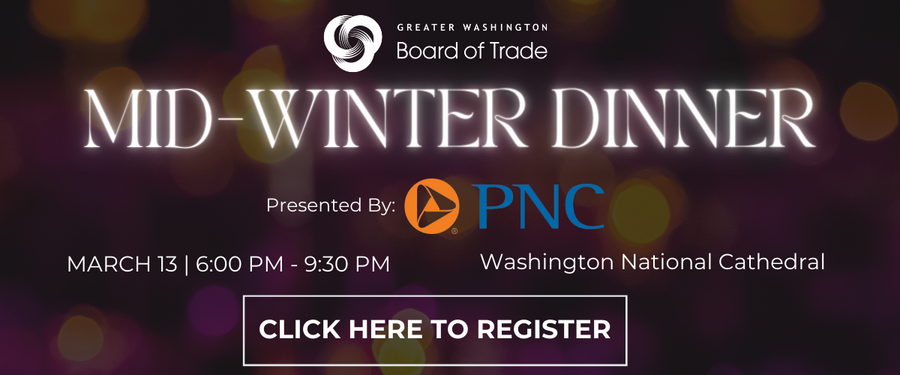
Mid-Winter Dinner at Washington National Cathedral
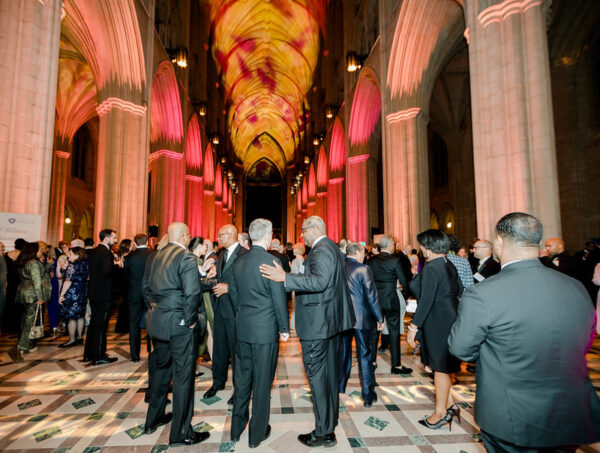
Join us on March 13 at the Washington National Cathedral for our premier event, the 104th Mid-Winter Dinner, presented by PNC Bank. This exclusive black-tie event is your chance to connect with business, government, and community leaders outside the office. Experience a pre-dinner cocktail reception, followed by a seated 3-course dinner, creating valuable connections with key players in the region. Don’t miss this extraordinary night of camaraderie and collaboration – secure your spot now and elevate your presence at the heart of the action!
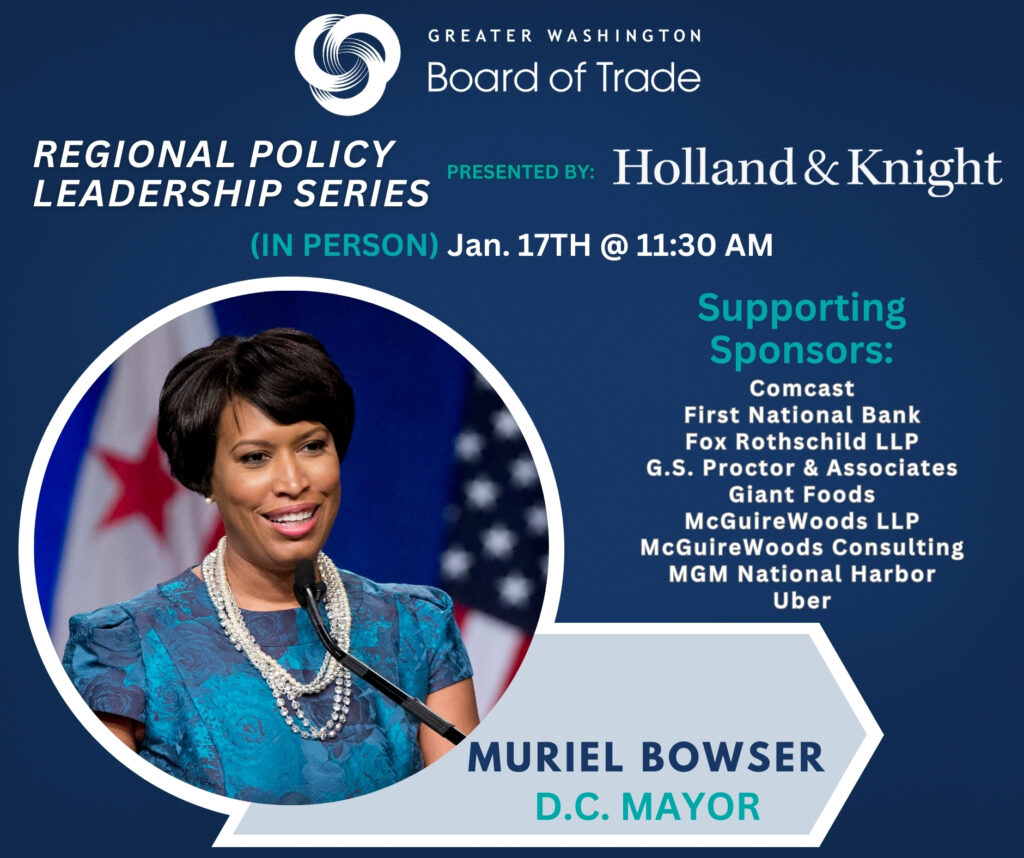
Regional Policy Leadership Series kicks off with DC Mayor Muriel Bowser
We are pleased to welcome Mayor Muriel Bowser next week at our in-person Regional Policy Leadership Series event on January 17. Join us for a thought-provoking discussion addressing critical issues within DC’s Central Business District. Mayor Bowser will delve into pressing topics such as efforts to enhance public safety, WMATA’s budget-related impacts, and the ongoing challenge of downtown revitalization amidst the prevailing work-from-home dynamic affecting businesses in the District.
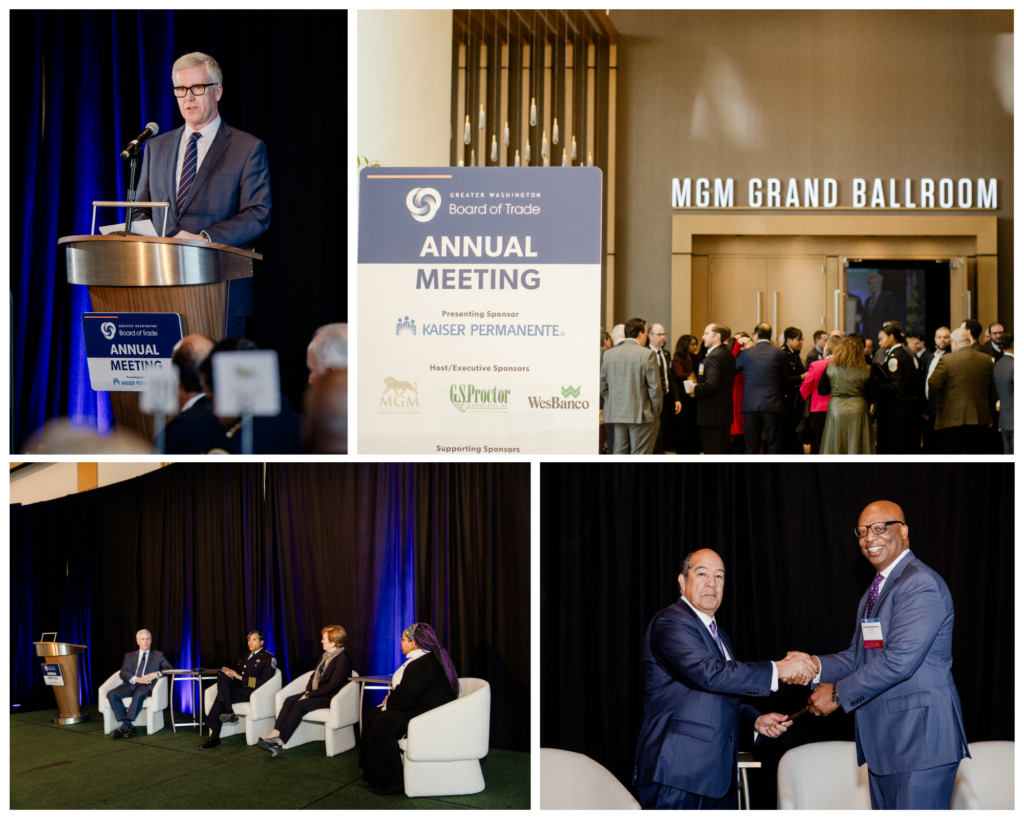
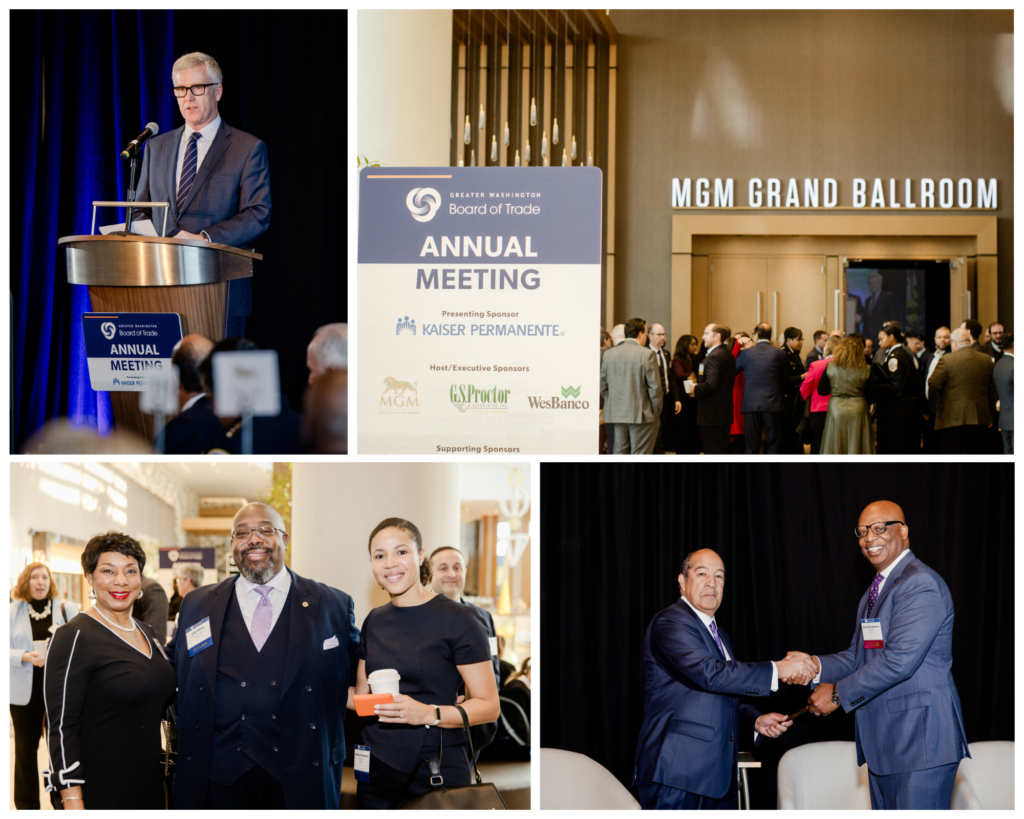
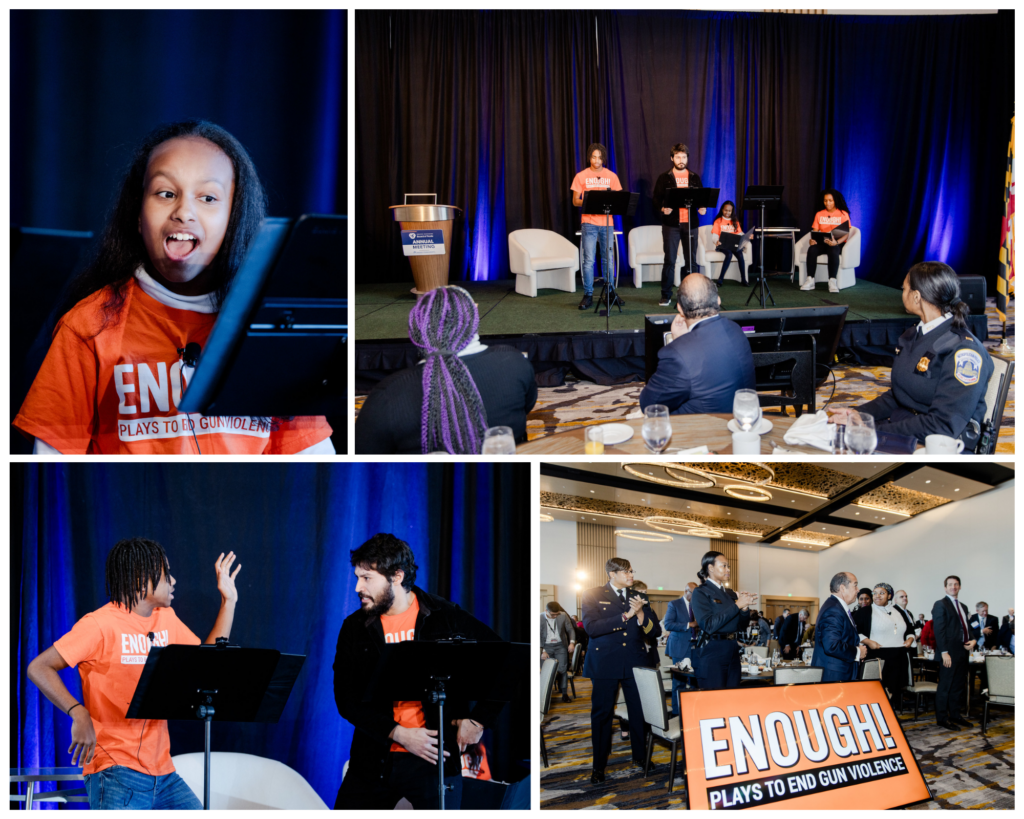
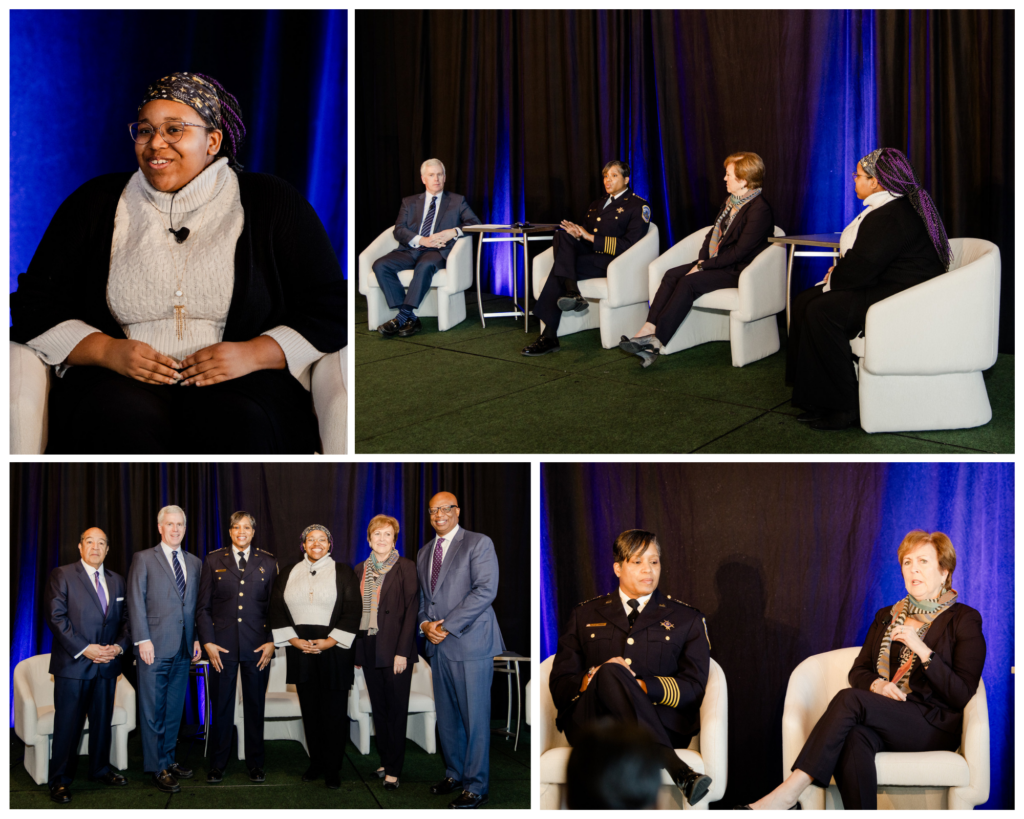
The Board of Trade’s 2023 Annual Meeting at MGM National Harbor was a resounding success! Our outgoing chair, Jermaine Johnson, and 2024 Chair, Steve Proctor, outlined some noteworthy highlights, such as a remarkable 90% member retention rate, an expansion of policy efforts, and strategic plans to address the significant funding gap for WMATA. Presenting sponsor Kaiser Permanente’s Ruth Williams-Brinkley shared their alignment with the Board of Trade and our mutual mission to build healthy communities. Deborah Rutter of the Kennedy Center emphasized the pivotal role of the arts in public safety, featuring discussions on its economic impact and community well-being. A compelling table read from ‘Enough: Plays to End Gun Violence,’ crafted by playwright Niarra C Bell, ignited a panel on crime prevention with MPD’s Chief of Police, Pamela Smith. As we approach 2024, our focus remains on tackling new challenges, advocating fervently, and implementing targeted initiatives to keep our region competitive, engaged, and inclusive.
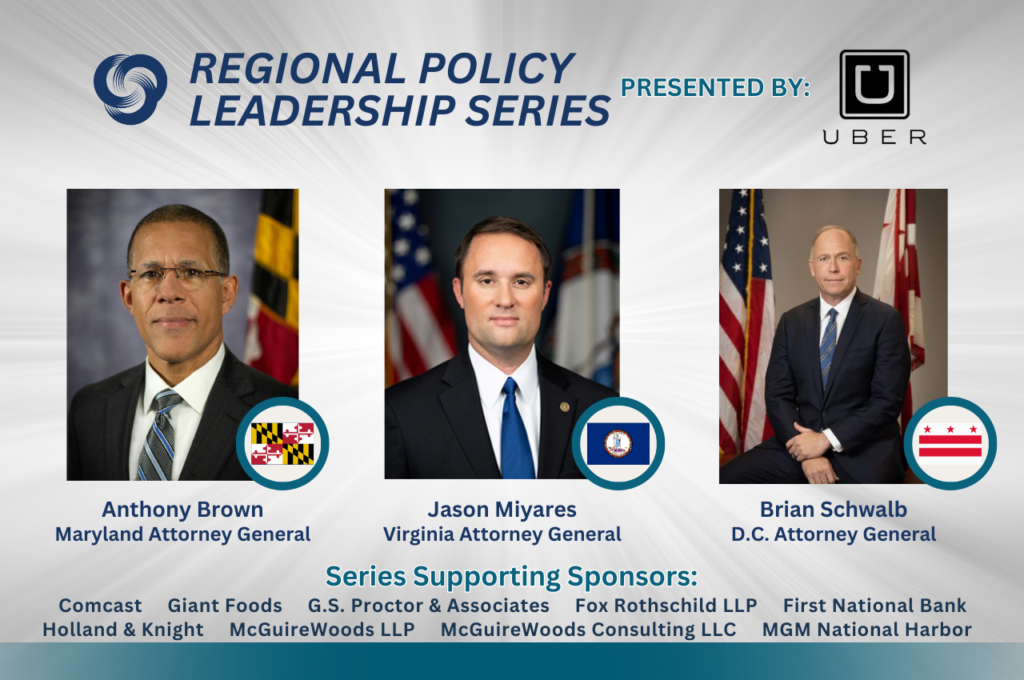
The Board of Trade brought together the Greater Washington region’s attorneys general in mid-December to discuss important issues and topics surrounding Washington D.C., Maryland, and Virginia. Topics ranged from the ongoing Meta lawsuit, the impacts of artificial intelligence, and how our top legal officials in Greater Washington are combating the epidemic of crime in the region.
The Board of Trade’s 2023 Annual Meeting, presented by Kaiser Permanente, was held on Dec. 12 at the MGM National Harbor Resort in Oxon Hill, Maryland, and recapped a year of growth for the Board of Trade. The meeting brought together nearly 300 members of GWBOT to celebrate recent accomplishments, look at the year ahead for the organization, and discuss the importance of the arts to the Greater Washington community, specifically in the context of violent crime, as it has become such a prominent area of concern in the region.
From the Stage:
Board of Trade President & CEO Jack McDougle, outgoing Board Chair Jermaine Johnson, and incoming Board Chair Steve Proctor started with discussions of what the Board of Trade has accomplished over the past year and where they see the organization moving over the next. This included sharing a 90-percent member retention rate for 2023, the growth of our policy and advocacy department to push forth and make an impact on our members’ positions in the region, how we will work with our partners to address the critical $750 Million funding gap for WMATA/METRO, and how we will continue to address growing public safety issues for regional businesses. The annual meeting also allowed a vote to confirm the upcoming GWBOT Board of Directors and introduce new 2024 Board Officers as part of the excitement for our organization heading into the new year and how we can enhance our impact, grow membership, and maximize member engagement.
We also had the pleasure of hearing from Ruth Williams-Brinkley, President at Kaiser Permanente Mid Atlantic States, on the great work Kaiser is doing to build healthy communities in our region before handing the discussion off to Deborah Rutter, President of The John F. Kennedy Center for the Performing Arts, who introduced the primary topic of conversation around the vital importance of the arts to the region, remarking on the enormous value of arts and culture for the region’s businesses, as well as the role that access to the arts plays in the mental and general wellbeing of the rest of the region’s communities.
In discussing what the region might look like without museums, arenas, theaters, and gathering spaces that shape the civic lives of residents, Deborah discussed a recent National Endowment for the Arts and Americans for the Arts poll in which 86% of respondents say that the arts vastly improve their lives in their communities and that arts in the non-profit sector make up a $13.8 Billion chunk of the DC economy and around $50 Billion regionally. Concluding that arts and entertainment are not luxuries but that they are necessary for prosperous communities, she mentioned some of the Kennedy Center’s community outreach work, including the National Symphony Orchestra’s ‘In Your Neighborhood’ program, which largely centers around bringing access to the arts to Ward 5 across non-traditional settings, and grassroots organizations participating in programs like the Cultural Caucus, which provides space and funding for local communities to curate the arts programming that they care about.
Deborah’s focus on art for non-art outcomes led to the presentation of a table read for playwright Niarra C Bell’s The Smiles Behind, a play born out of Enough: Plays to End Gun Violence, a program that asks teens to submit short works around gun violence and provides a platform for young artists.
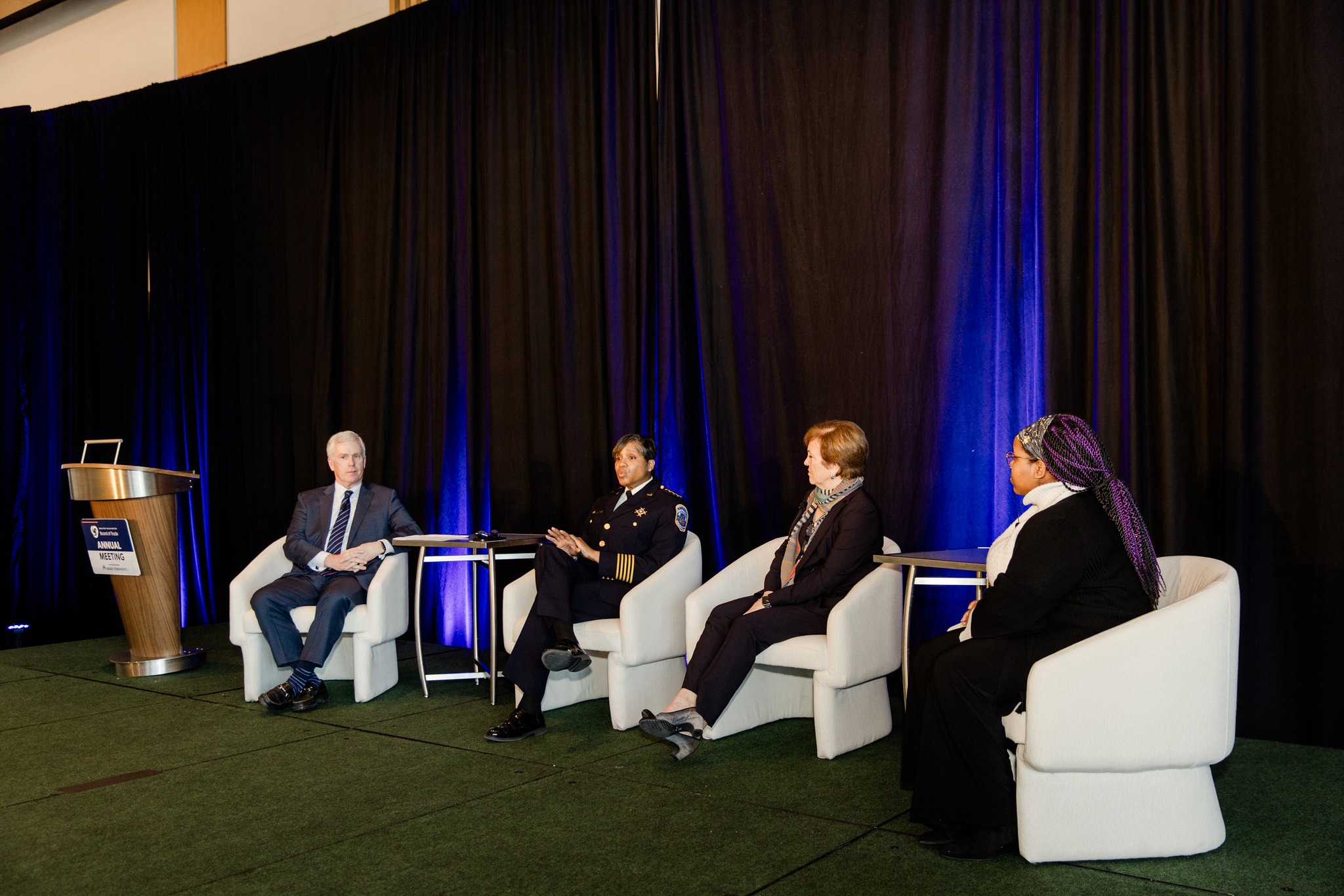
The performance was followed by a panel discussion in which Jack, Niarra, Deborah, and Chief Pamela Smith of the Metropolitan Police Department discussed violent crime in the region as contextualized by the play. Jack, moderating the panel, started the discussion with a personal anecdote about his experience with violent crime in the region before passing the discussion to the panelists. Chief Smith discussed her background, including how she came to be an integral part of the national law enforcement community and some of the broad impact that she has seen community-centric cooperative policing have on DC’s residents.
Deborah discussed her experiences with the large-scale defunding of arts education shortly after the start of her career. She reflected on the critical role that arts education and arts educators had on her life during her formative years before transitioning into a discussion of how the Kennedy Center represents a unique local and national platform for every form of art within the region and how its significant role has been an enormous part of the region’s cultural focus on the arts.
Niarra then discussed how increasing rates of gun violence can hit close to home in communities that aren’t expecting it and how such an instance led her to get involved with theater and later into arts advocacy and remarked on the importance of giving a platform to young voices as a part of the conversation about criminal justice reform.
The conversation then shifted more toward violent crime prevention as Chief Smith expressed a desire to partner with the Kennedy Center to help educate new officers and create a more humane policing community by sharing art like The Smiles Behind with new officers. She went on to discuss the arrest of 10 juveniles involved in a carjacking ring (an alarming issue in the District) and the impact that new programs like Operation ATLAS and the District’s new gun trafficking unit have had since their creation on the crime rates in the region. Also, Chief Smith spoke about future programs like the District’s crime center, which will be reaching out to the region’s business community to provide CCTV access in concert with the Mayor’s plan to double the number of CCTVs in the District, a measure which has substantially reduced crime elsewherel. Chief Smith concluded by discussing the importance of holding youth accountable and avoiding a culture where juveniles feel untouchable by the law.
Niarra echoed Chief Smith’s sentiments about the necessity of holding juveniles accountable, further discussing how the lack of accountability can lead to many of the problems communities can experience wherein bystanders can be grouped in with bad actors before Deborah concluded the discussion by calling out Duke Ellington High School’s gun violence support group, recently featured in the Washington Post, as being an incredible example of community support of those impacted by the region’s pandemic of violent crime.
Thank you to all our members for contributing to the work of the Board of Trade that helps our region and business community to stay competitive, engaged, productive, and inclusive to all who live and visit!
In 2024, we anticipate fresh challenges coupled with abundant prospects. Drawing from our enduring legacy in this region, the Board of Trade is unwavering in its dedication to amplifying your achievements and bolstering our region’s competitiveness. We’ll advance this by nurturing stronger connections, advocating more powerfully across federal, state, and local arenas, conducting in-depth analyses, and rolling out specific programs and initiatives.
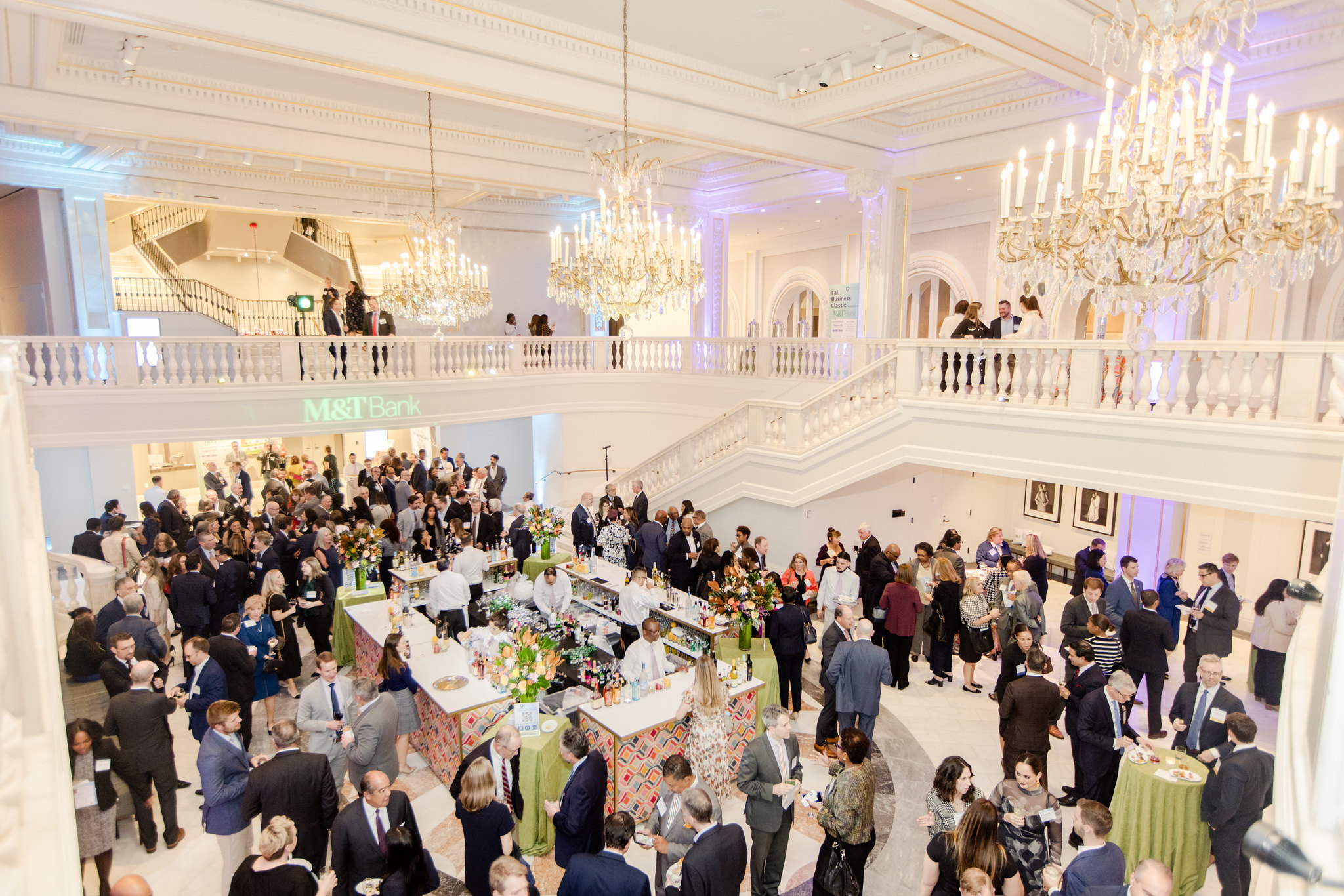
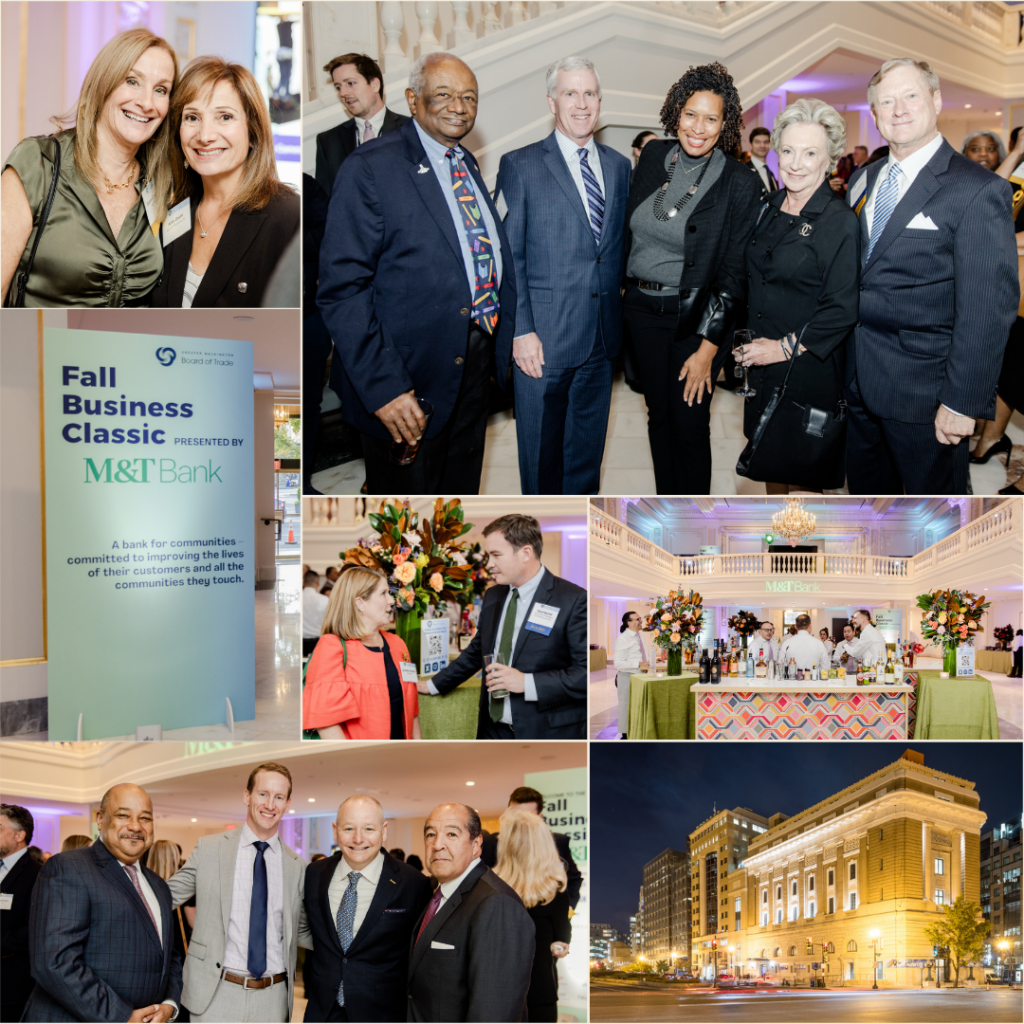
The Greater Washington Board of Trade gathered more than 400 regional leaders and business professionals for our 30th Fall Business Classic on Oct. 26 at the National Museum of Women in the Arts. This annual gathering celebrates the importance of working together to connect our business community.
The evening was highlighted by a spectacular and newly renovated venue, fascinating museum exhibits, and engaging conversations on regional business topics, which created a high-energy event.
Regional collaboration is at the core of the Board of Trade’s mission, which makes convening the region’s leading business executives, community partners, and elected and appointed officials for meaningful conversations a valuable part of enhancing our region and its communities.
Since our establishment in 1889, the Board of Trade has a history of bringing our region together for meaningful dialogues that lead to action. Over the decades this has included initiating D.C.’s subway development in the 1930s, helping form parks along our beautiful rivers, pushing for the development of the region’s airports, and helping bring organizations together to build entertainment and sporting venues in our region.
We’d like to extend our thanks to all the sponsors, participants, and staff who put in tremendous effort to make this event a success. We look forward to continuing to build a brighter future for the Greater Washington region, one meaningful connection at a time.
This 2023 Fall Business Classic was presented by M&T Bank. Supporting Sponsors of this event are Bank of America, Bechtel, Capital One, Giant Food LLP, Miles & Stockbridge P.C., National Museum of Women in the Arts, Pepco, Ridgewells, Washingtonian Magazine, Wells Fargo, Western Transportation Group.
Math is not just about equations but a vital skill for daily problem-solving, business success, and even landing on Mars. And in the Greater Washington region, it will help our communities grow, helping younger generations tackle issues facing transportation, economics, healthcare, and so much more.
Board of Trade President & CEO Jack McDougle joined WTOP and the Collaborative for Student Success in a discussion about why math matters for community success, why we need to help rebrand it to make it more popular to younger generations, and how we can help support its growth and necessity.
Below is the view interview from our discussion with WTOP. Read the full readout of the interview here.
https://www.youtube.com/watch?v=Lf_FsUyTTYs&t=1s
Check out more content from our partnership with WTOP to showcase how businesses in our region are helping grow and create stronger communities in Greater Washington here.
Want to learn more about upcoming events that help you engage in the Greater Washington business community? Stay up-to-date on Board of Trade events here: https://www.bot.org/events