Statement on the Capital Beltway Accord

Statement on the Capital Beltway Accord

Statement from the Greater Washington Partnership and Greater Washington Board of Trade on the historic Capital Beltway Accord between Maryland and Virginia

Washington, D.C.—Jason Miller, CEO of the Greater Washington Partnership, and Jack McDougle, President and CEO of the Greater Washington Board of Trade, today released the following statement on the Capital Beltway Accord announcement by Maryland Governor Larry Hogan and Virginia Governor Ralph Northam:

“The announcement made today by Governors Larry Hogan and Ralph Northam is a momentous step towards improving the performance and reliability of our transportation system. The American Legion Bridge is the link between Fairfax and Montgomery counties, which host over 35 percent of the region’s jobs and households. It is a critical connection, yet it is well beyond capacity and the resulting traffic creates daily frustration and lost productivity for the region’s residents, workers, and employers.

“Today’s announcement is the beginning of a serious cooperative effort to give these commuters their valuable time back. Doing so will be a win for the entire region that will dramatically enhance our ability to attract and retain workers in the Capital Region and compete in the global economy. It shows that by working together we can overcome massive challenges to best serve all of our residents. We applaud Governors Hogan and Northam for the historic Capital Beltway Accord and are committed to working with these leaders, Mayor Bowser and other key officials to continue building momentum for game-changing regional cooperation.”

About the Greater Washington Board of Trade
The Greater Washington Board of Trade is a nonpartisan business organization and has represented all industry sectors in the District of Columbia, suburban Maryland and Northern Virginia for 130 years. The Board of Trade works collaboratively to advance polices, practices, and actions that benefit its members and improve the business environment and quality of life across the region.

About the Greater Washington Partnership
The Greater Washington Partnership is a first-of-its-kind civic alliance of CEOs in the region, drawing from the leading employers and entrepreneurs committed to making the Capital Region—from Baltimore to Richmond—one of the world’s best places to live, work and build a business. Working in collaboration with leaders across our communities, the Partnership connects and leverages the region’s extraordinary assets to advance inclusive, actionable solutions that strengthen the Capital Region as a leading global region and center for commerce and innovation.

Contacts

Lindsey Longendyke
980-322-9904
[email protected]

Steven Chlapecka
202.871.9914
[email protected]

Tips for boosting diversity and inclusion in your business

Sheree Anne Kelly, CEO of the Association of Chamber of Commerce Executives

Every quarter, the Board of Trade hosts chamber of commerce executives from across the region for a conversation on shared priorities. At our last chambers’ meeting in July, Sheree Anne Kelly, CEO of the Association of Chamber of Commerce Executives, graciously presented her organization’s research on diversity and inclusion programs. Her insights are drawn from leading studies as well as the successes of ACCE members from around the country.

I interviewed Sheree Anne on how organizational leaders should approach a diversity and inclusion effort so that our members could also benefit from her expertise on this critical topic.

Social inclusion is a big topic. How do you define it?

Sheree Anne Kelly: The easiest definition is for organizations to try to make all types of people and all groups of people feel valued and heard in whatever ecosystem they are in. But there is an interesting and worthwhile distinction among diversity, equity, and inclusion.

Here’s a simple way to illustrate the difference: “Diversity” means that everyone gets invited to the party. “Equity” means that everyone can contribute to the playlist. “Inclusion” means that everyone can dance.

The nomenclature matters because a lot of people will say, “my focal point is diversity,” which means they are concerned with whether the individuals present are diverse. But if you want to dig deeper, you have to look at things like equity and inclusion. You can have diversity, but it means nothing if they can’t participate.

They all go hand in hand, but in general you want to move in a trajectory towards equitable and inclusive decision-making.

Why is it important that organizational leaders pay attention to diversity and inclusion?

The statistics show that demographics are changing rapidly in many of our communities. As a business leader, you want to think about your organization changing and adapting to address that. If you’re not tracking data that’s available in your community, you might not be getting ahead of those trends. For example, is your community gaining more immigrants? From where? Are older adults seeking to return to the workforce after they retire? Or are parents looking to return to the workforce? What are you doing to make your business an attractive place for these people to work or become customers?

Of course, making your business more inclusive is about doing the right thing, but it’s also really good for the business bottom line. Studies show that diverse and inclusive businesses have a higher net income than their counter parts that don’t. On a macro scale, other research shows that communities do better when there’s diversity and those different groups get along.

Sheree Anne leads a conversation on diversity and inclusion at the Chambers Dinner hosted by the Board of Trade in July 2019

How have corporate diversity programs evolved over the years?

One change I’ve seen is in how we define diversity. Historically, it was focused on race and ethnicity but now leaders are increasingly looking at gender, age, sexual orientation, geographic location, opinions, talents, backgrounds—a much broader definition, which makes it a better conversation when you’re looking at driving outcomes within your own organization.

Another big change is that this effort is moving away from being a separate department. Diversity and inclusion increasingly create a lens through which you view all your business activities. It’s less about numbers and counts and quotas, which was a hot topic a few years ago. Now it’s about looking at your staff, your governance, your leadership, the speakers you bring in for events, your vendors, your suppliers, your customers, and asking, do these stakeholders collectively represent the diversity of our community?

What common mistake should leaders try to avoid when attempting to create a more inclusive workplace or business?

I get very frustrated by diversity for diversity’s sake. If you say, “I’ve hired a fill-in-the-blank person,” that’s not enough. You have to think about your needs and your community’s needs. You have to have a more holistic view.

Also, even if leaders have a diverse team, they have to ask themselves if the whole team is empowered. Are everybody’s voices heard? Can everybody affect change? Again, diversity doesn’t mean much if each segment doesn’t have the same ability to affect change.

What sign should leaders look for to know that their organization is as inclusive as it should be?

Here’s a big one: does your organization embody a learning culture? You need to constantly be asking for feedback and using that feedback to adapt. Are you asking your employees for their perspective? Are you training your team on areas that are shifting in your community? If you’re being nimble, that’s a great sign. That means being nimble internally and externally—how you work with your staff and how you work with your community. If there’s a good pace of change, that’s a good sign.

How can an organization develop that kind of learning culture?

It has to start from the top. If senior leadership isn’t willing to be challenged, it’s not going to work for the rest of the organization. Management has to create a safe space where staff can feel comfortable voicing disagreements and bringing up challenges.

Some groups will train their staff on unconscious bias, which can be very effective at showing how it’s innate in our nature to have unconscious bias towards certain segments of society. Just recognizing that can help people adjust the way they approach their colleagues and the rest of the community. It’s also useful to have conflict management training. Investing in these kinds of development opportunities can go a long way towards helping a team deal with diverse opinions and get to an optimal decision.

How can organizations increase internal diversity?

A lot of companies complain about not being able to get a diverse enough pool of candidates or potential board members. I always ask them to reconsider their outreach processes. Perhaps they need to explore new places to post their open positions. For the board, companies tend to ask their current board members to bring in people they know—which usually means you get more of the same kind of people. Companies should challenge themselves to reach beyond their own network and cast a wider net to find new talent.

United Airlines’ Evan Koppel on Doing Business in the Region

Evan Koppel, Board of Trade member and regional sales director at United Airlines

United Airlines moves over 20,000 people through its hub at Washington Dulles Airport on an average day, giving the company a unique perspective on our market and how it has evolved over time. I spoke with Evan Koppel, regional sales director at United, about the company’s experience and how it has seized opportunities through partnerships.

How has the Greater Washington market changed over recent years, from the perspective of an airline?

This region has a very strong demand for travel, thanks to the large corporate base, federal government, and tourism to the National Capital region. But another trend is driving more visitors to the Washington region in particular—the influx of cyber security and tech companies setting up shop here, including West Coast tech companies, which has generated a lot more demand.

Over the years, the cost of doing business at Dulles has fluctuated. When we made it one of our East Coast hubs, it was not expensive for airlines to operate there but the costs went up at the airport, which increased our cost of doing business.

Luckily, over the past few years, MWAA (the Metropolitan Washington Airport Authority) has been a great partner and has focused on bringing costs down at Dulles and working with us to improve the airport experience for passengers. We’re happy with how things have evolved in recent years and excited to see continued growth. Additionally, the completion of Phase 2 of the Silver Line next year will provide Metrorail access to customers traveling to/from DC and around the region.

I understand that MWAA is a key partner for United in this region. Have you learned any lessons from that partnership that you can share with other Board of Trade members who may be exploring cross-sector partnerships?

MWAA represents Reagan National and Washington Dulles International airports, and we work with them at both but especially at Dulles since it’s one of our hubs. We want to serve more customers and give those passengers a good experience.

MWAA is a fantastic partner. They are open to new and creative ideas. They support us on marketing and events that promote Washington Dulles, such as the Board of Trade dinners that we’ve co-sponsored. They also proactively help us identify new domestic and international markets that could help us grow our hub.

The partnership works great because we collaborate and communicate frequently. We meet regularly and keep each other informed on our respective strategies for growth. We both have a very clear shared goal of increasing customers on United; having a good cadence of communication enhances this relationship and sets clear direction.

United recently invested in a new Polaris lounge at Dulles. What motivated United to make this investment?

We found that lounges are a point of competition for airlines. They make a difference to a customer’s travel experience. We researched and invested significant resources to rebrand our business class product as Polaris and build Polaris airport lounges for international business class travelers.

These lounges provide a great award-winning product in our hubs where other United Polaris lounges are already in place, and we’ve seen and heard how it positively affects our customer satisfaction scores and enhances the whole experience. In fact, our San Francisco Polaris lounge was just named the best airport lounge in the world! In the soon-to-come Dulles Polaris lounge, passengers will get full-service dining that brings in local flavors and cuisine. There will be showers and places to relax or take a nap. It will be a unique experience for our international business class customers.

The Polaris lounge at our Washington hub is currently under construction and slated to open in 2020. This investment excites us because Washington has a very large transatlantic footprint – the second largest number of flights to Europe behind our Newark hub. We also have flights to Asia, South America, and we recently started service to the Middle East with our new route to Tel Aviv, which we launched in May. It made sense for us to make this significant investment.

What is the most important thing that the Board of Trade community can be working towards to strengthen this market?

We have a great relationship with the Board of Trade and we applaud their efforts in the many areas where we align. We have a beautiful region with great scenery, culture, restaurants and shopping, but some of the infrastructure, including bridges and roadways, may need some attention. In addition, any initiative the Board can focus on to drive more business growth and connectivity is welcomed.

We want to create a positive view of our community to visitors. We all have a role in this area. We each can play a part in contributing, supporting, and influencing changes to our business environment and infrastructure and promoting this great region. The Board of Trade has been invaluable in helping encourage Virginia, Maryland, and the District of Columbia to dedicate additional funding to the Metro system last year, and there are many other areas where they have successfully spearheaded change. We should keep up support for that kind of important work.

Recap: Smart Cities Expo

Earlier this month, the smart region team participated in the Smart and Secure Cities and Communities Challenge Expo. This was a national event hosted by the federal government to drive productive conversations on smart city technology in the United States.

In her keynote address, Diane Rinaldo, Assistant Secretary of the National Telecommunications and Information Administration (NTIA), made the case for regional collaboration. Like Greater Washington, many metropolitan areas across the country are made up of multiple smaller jurisdictions. Sometimes these metropolitan areas cross state lines. This fragmentation can pose political and administrative barriers to deploying new infrastructure for the whole metropolitan region, even when the people who actually live and work in these areas cross jurisdictional borders every day. Rinaldo stressed that by making the effort to work regionally, metropolitan areas can deliver greater benefits to residents and workers while enjoying economies of scale.

Continuing the conversation on regionalism, Board of Trade CEO Jack McDougle represented Greater Washington on the smart region plenary panel. Jack spoke on our region’s longstanding challenges with inequality and our uniquely intricate patchwork of local, state, and federal government entities. He explained that our approach is unique in that it is focused on collaboration and social inclusion, so that all residents benefit from what smart city technology has to offer.

Two congressmen spoke: Brendan Boyle (PA-02) and Paul Tonko (NY-20). Congressman Boyle stressed that modern infrastructure is much more than bridges and roads. We must think about infrastructure in a smart way, leveraging all that modern technology has to offer. Congressman Tonko stressed the need for government leaders to embrace opportunities to make our communities more connected, citing economic development and sustainability benefits.

Karl Darin, Vice President of the Greater Washington Smart Region Movement, represented our region at the Smart Regions Collaborative session, where metropolitan regions from around the country presented on their approach to deploying smart initiatives.

At that evening’s reception, Lindsey Parker, Chief Technology Officer for the District of Columbia, spoke on her office’s priorities. She explained that we must “open up the technology box” and make the value proposition clear and understandable for the general public and their elected leaders. She called on greater collaboration among government agencies, universities, and business. She then praised the Greater Washington Smart Region Movement for taking this approach.

Since this was an expo, the Greater Washington Smart Region Movement had a booth. Smart City Media donated a live wifi kiosk that served as an example of the kind of useful, connected technology we will deploy regionally.

We were glad to participate in this national event and to see how our approach in Greater Washington compares to those in other regions. More than ever, we believe that we can be the nation’s leading digitally enabled region and set an example for communities around the country.

What We Can Learn From Washington’s History of Revolutionary City Planning

The Washington, D.C. area is admired around the world for its parks, monuments, stately architecture, and attractive urban spaces. But the region would look very different if it were not for the bold, innovative thinking that guided its planners nearly 120 years ago.

At the turn of the 20th century, American cities typically grew in market-driven, haphazard spurts. Water and sewage systems were managed by public authorities, but few other aspects of urban development were subject to any coordinated planning.

Washington became an exception. In 1900, the Board of Trade organized a lavish event to celebrate the 100th anniversary of the District becoming the nation’s capital. This was an inflection point for the city, which had become a source of national pride. Prominent Washingtonians asked themselves, how could the city better represent the culture and values of the United States?

At the time, the American Institute of Architects believed that the capital should be shaped by the nation’s best architects and artists. They envisioned grand, beautiful, and aesthetically unified buildings and public spaces. They sought the “American Renaissance” style, which embodied public order, progress, refined taste, patriotism, national wealth, and power.

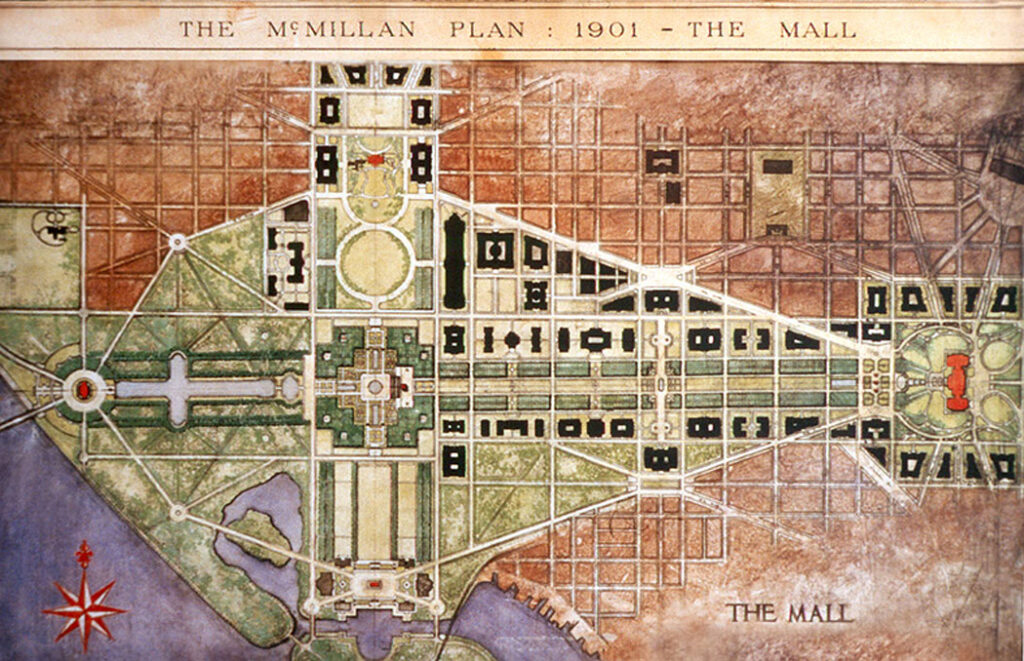
The National Mall was the centerpiece of the McMillan plan.

Meanwhile, the Board of Trade pushed a strategy focused on parks. A large and well-maintained network of parks would ensure that individuals and families had access to natural spaces as the city grew in population. Indeed, our region’s park system has had a positive effect on air and water quality, public health, social ties, and even our local economy by making the region a more attractive place to live, work, and visit.

In 1900, Senator James McMillan introduced a resolution in the Senate that would accommodate varying viewpoints on design improvements to the capital. With the support of the Board of Trade, the resolution called for the president to appoint a panel of professional artists and architects who would work together to design the National Mall as well as a system of parks within and around the District.

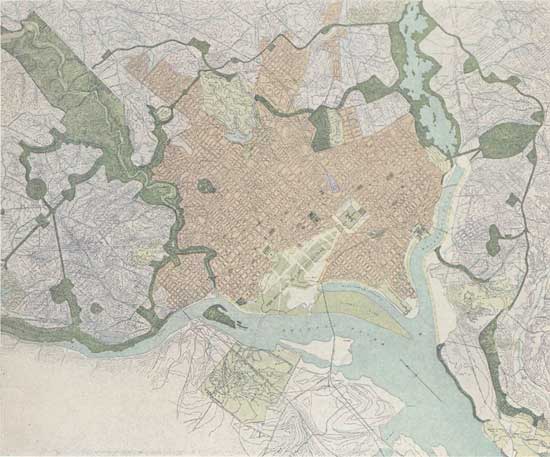
The result was the radically comprehensive Senate Park Commission plan, also known as the McMillan plan, which guided continuous development of the nation’s capital over many decades. The plan transformed the Mall from a disjointed collection of smaller parks into a grand grassy lawn surrounded by historical museums, elm trees, fountains, and monuments. It replaced miscellaneous red brick buildings with stately white neoclassical ones. It removed a railway station on the Mall and replaced it with a large, modern station north of the Capitol Building—which is now Union Station. It called for new office buildings for federal agencies to be built in Lafayette Square and Federal Triangle. It included the Memorial Bridge across the Potomac River. And it established a huge network of public parks, playgrounds, and other public outdoor amenities, all connected by a series of parkways and extending out as far as Rock Creek Park, Great Falls, and Mount Vernon. Residents and visitors now enjoy these unique places and resources, most of which are maintained for all Americans through the stewardship of the Department of the Interior.

The dark green areas indicate additional park land proposed by the McMillan plan.

The scope of the McMillan plan was massive, which was not originally the objective. Senator McMillan had asked the team of architects to put forward a preliminary plan outlining incremental improvements to the area because those were more likely to get funded by a fiscally conservative Congress. But the team didn’t listen. They instead laid out their vision for the whole region and sought both function and beauty. They designed for the whole, not just the parts. Their bold, innovative thinking made the Senate Park Commission plan one of the most influential urban plans in American history.

This story is a reminder to think big. Local politics, funding concerns, and competing interests can marginalize great ideas. Our tendency to label bold visions as unrealistic dissuades us from thinking ambitiously. In recent years, this has held our region back from tackling tough problems related to transportation, housing affordability, social inequities, and other factors that impact quality of life.

The Greater Washington Smart Region Movement is our next chance to think big. Our vision is for a region that seamlessly uses digital technology to operate more smoothly while making life better for the people who live, work, and play here. To get there, we’ve formed an exceptionally inclusive coalition of organizations—nonprofits, companies of all sizes, academic institutions, government agencies—to design a strategy that serves the whole region. It will be a long and complicated process and we sincerely appreciate the dedication and support of our members and the broader community.

I’m grateful that the Board of Trade and the team of architects behind the Senate Park Commission plan allowed themselves to boldly and responsibly envision a better future, and I know that the work we are doing now will have the same positive impact on the generations ahead.

How Fast, Reliable Connectivity Will Advance the Greater Washington Area

This post was guest authored by Cathy Piche, East Area President at Crown Castle.

When Amazon first released its RFP for building a second headquarters in North America, the company received nearly 230 proposals from cities and regions across the U.S., Canada, and Mexico. The tech giant narrowed down the list of potential candidates to 20 locations, and it was no surprise that Washington, D.C.; Montgomery County, MD; and Northern Virginia were included as the top contenders for being business-friendly and stable environments with the potential to attract and retain strong technical talent. While Amazon ultimately selected Crystal City, VA for its second headquarters, the decision was hailed as a tremendous win for the entire Capital Region.

As the Greater Washington metropolitan area prepares for the impending arrival of HQ2, local leaders must focus their attention on connectivity, one of the key requirements stated in the RFP to remain competitive today and prepare for the opportunities of tomorrow. This will require upgrading our existing communications infrastructure with fiber optics and a robust small cell network, which are small nodes that are attached to structures in the public right of ways like streetlights or utility poles. This infrastructure will bring fast, reliable wireless connectivity to Washingtonians.

The Capital Region continues to grow, and so does the demand for more data, in more places, at faster speeds than ever. In a world where smartphone traffic is expected to increase 12 times by 2021, small cells add much-needed capacity and coverage in highly-populated areas. This is especially important for public safety given 80% of 911 calls are made from wireless phones.

Small cells will pave the way for next-generation networks such as 5G which promise to deliver smart city innovations, including autonomous vehicles and citywide data sharing. 5G will also unlock economic benefits. As CTIA estimates, “Over the next five years, the U.S. will see benefits across the country, including 3 million new jobs, $275 billion in new investment, and $500 billion in economic growth.”[

Crown Castle applauds the Greater Washington Board of Trade, the Metropolitan Washington Council of Governments, and the Consortium of Universities of the Washington Metropolitan Area for collaborating to shape and advance the smart region plan. Crown Castle looks forward to working with local leaders and stakeholders to prioritize the deployment of fiber optics and small cells solutions and better connect the Capital Region. As the nation’s largest provider of shared communications infrastructure, we are committed to keeping people connected and safe, helping our partners set the stage for the future, and ensuring that businesses and communities thrive.

About Crown Castle

Crown Castle owns, operates and leases more than 40,000 cell towers and approximately 70,000 route miles of fiber supporting small cells and fiber solutions across every major U.S. market.  This nationwide portfolio of communications infrastructure connects cities and communities to essential data, technology and wireless service – bringing information, ideas and innovations to the people and businesses that need them.  For more information on Crown Castle, please visit www.crowncastle.com.

The Future of Farming in Greater Washington: Interview with Lindsay Smith

Earlier this year, the Metropolitan Washington Council of Governments (MWCOG) published What Our Region Grows, an assessment of the state of agriculture in the region. We interviewed Lindsay Smith, regional food systems value chain coordinator at MWCOG and author of the report, on trends in this sector.

When people think of this region, they think of the federal government, our history, and increasingly a growing technology sector. Why is agriculture important to Greater Washington?

Agriculture generates jobs and revenue for the region, but there are a lot of indirect benefits as well. For example, by preserving land for the sector, we are better incentivized to use smart planning on other land used for residential or commercial purposes. Montgomery County is a great example of how making a commitment to land preservation plays a role in limiting low-density development over time, concentrating new growth and redevelopment into communities that can be easier to service with transit, made more walkable, etc.

That preserved, agricultural land is also a sound long-term investment because you can get these benefits without huge costs to the jurisdiction. Unlike residential development, agricultural lands don’t put the same demands on police, fire, EMS, or schools, so there’s long-term fiscal impact of stronger, preserved agricultural regions.

Farms also boost livability. Increasingly, the metro area is known for great restaurants. But we also have great wineries and opportunities to pick your own food. There are all types of agricultural tourism opportunities that farm business owners are taking advantage of, including in our more urban communities. Longer term, could our region have the same kind of reputation as the Hudson Valley, but with our own unique landscape and culture and all the wonderful things that means for different food traditions? Could we as a region connect the dots between businesses, restaurants, farms, and great places, and create one more reason why this is an attractive place to invest?

I’m hopeful that the region can come together and collaborate in a more strategic way to support the agricultural sector. There are just certain things we need to have as a society to function well, and agriculture is one of them. There’s a resiliency angle here, too—do we want to increasingly rely on other places for our food, or do we want to have a viable food system that can also provide nutrition?

Tell me about that. Why is it important for us to provide food for ourselves?

Being able to produce what we eat would be a big step forward for our resilience in the event that other regions that supply food are unable to do so. Many farmers will tell you that last year was devastating—it was the rainiest year on record here, and it ruined a lot of crops. Those kind of historically unusual weather events are happening in other places, too. So, we might not want to assume that we can always source food from the places we’ve typically sourced it from with the ease that we do today. If we diversify our food sources, we diversify our risk.

The report describes a big reduction in agricultural output in the last century, especially in the last 10 years, but our population has grown. What factors are making farming more difficult in our region?

This tends to be industry-specific, and the dairy industry has been hit the hardest. It’s not an exaggeration to say that we are losing dairy farms every month. Dairy farmers across the country are all struggling because the price of milk has remained lower than the cost of production for several years. It’s not economically viable, especially for smaller farms. Some are persisting or turning to direct markets which is great. Some are switching over to beef cattle while others are closing their doors.

Another factor is climate change. Most farmers would say that the weather in 2018 cost them something, but not all would connect it to climate change. It was a tough year. This is a humid region, which can pose challenges for growing things like wine grapes and hops. If you get too much moisture, it’s a challenge for lots of crops because it leads to fungus and disease. This year we saw some issues with outright flooding and ability to absorb more water. I haven’t heard of anyone who didn’t have a difficult weather year, outside of folks who are doing indoor farming.

Agriculture overall might be declining, but agritourism is seeing impressive growth. What’s behind that trend?

We have a growing number of innovative farmers and rural business owners who are starting new things. Some of our jurisdictions in the metro region have invested in agricultural marketing specialists who help farmers with new business ideas. Probably a growing interest in food and where food comes from is helping. Some of it may be driven by the growth in craft beverage, such as wineries, breweries, cider mills, and distilleries.

Some farms are also looking at creating a unique place and experience in addition to the products they sell. Look at Up Top Acres, for example. Part of their business is growing food and they have a community supported agriculture (CSA) program, but they also have some striking space with views of the Nationals stadium and the Capitol. It’s a space that can be used for events, whether it’s a celebratory dinner or a yoga class. So, there’s this trend with some urban farms to connect agriculture, food, people, place, and experience.

Agritourism is definitely part of the region’s future and the future of a lot of farms. Over the long-term, it can be an important business diversification strategy and another way to bring revenue to a farm and the region.

The report lists some recommendations for protecting and growing our farm sector. One recommendation is to improve public policies and regulations. Can you share an example?

The processes required by local, state, or federal regulations can be quite taxing for farmers. Most don’t have someone working full time on compliance, so whatever time they spend satisfying regulatory requirements is time they aren’t spending working their farm. Of course, we need farmers to adhere to food safety and other standards, but I’d like to see more awareness of the cost to the small and mid-sized farmer when a regulation is implemented. Can this awareness, along with greater coordination within government, drive greater efficiency in what’s required without compromising outcomes?

It’s like any industry that evolves in that the entrepreneurial action tends to be ahead of the regulatory environment. The first person to open a winery, an urban farm, or something that the community hasn’t seen before faces a longer process because they are the test case. Our hope is that if there could be some sustained, regional attention and sharing of best practices across jurisdictions, we could do our part to promote regulations that address concerns on health, safety, and welfare without slowing down innovation in this sector.

Where would you and your team like to see our agricultural sector be in ten years? What does success look like?

I would love to see that we are not losing more agricultural land, that we’re seeing growth in younger cohorts. One of the things our report talks about is that there’s a generational change that’s happening as our farmers retire. It’s not impossible but it can be difficult for new farmers to get started, especially if they don’t come from a farm family and don’t have access to land. Access to land can be a real challenge. So, we need to create opportunities for the next generation of farmers who are eager to join the industry, grow their business, and reach new markets.


Metro Joins the Greater Washington Smart Region Movement as Strategic Partner

The region’s transit agency will join the cross-sector effort to enable a trusted, secure, and inclusive “smart city” infrastructure for the public good.

WASHINGTON, D.C., April 16, 2019 – Today, the Washington Metropolitan Area Transit Authority (Metro) and the Greater Washington Board of Trade announced a strategic partnership to enable digital infrastructure and deploy smart technologies for the purpose of improving livability and driving inclusive economic growth. The announcement marks a significant milestone for the Greater Washington Smart Region Movement with Metro joining the Board of Trade, the Metropolitan Washington Council of Governments, and the Consortium of Universities of the Washington Metropolitan Area to collaborate on creating the nation’s leading digitally enabled region.

“Metro’s importance to our region’s success cannot be understated,” said Board of Trade President and CEO Jack McDougle. “We are very pleased to welcome them to the Greater Washington Smart Region Movement and know that together we can help our region confidently move ahead in a more digitally enabled society. It is increasingly clear that a strong digital infrastructure can improve mobility for everyone, in every neighborhood. We collectively see an opportunity to use smart technologies to make transportation more equitable, sustainable, efficient, and reliable.”

Metro and the Board of Trade have signed an agreement whereby they will work together to help move critical digital projects forward in our region. The framework being developed contemplates legal, policy, and regulatory elements; recognizes and augments projects currently underway; develops public awareness campaigns; and addresses other activities as defined by the Greater Washington Smart Region Movement.

“We are proud to be the first agency to sign on to this important effort to make the national capital region the most digitally enabled in the nation,” said Metro General Manager and CEO Paul J. Wiedefeld. “Just as our region has been a leader on so many fronts, I am confident that with shared goals, vision, and business and governmental leaders working together, we will set a new smart region standard. Metro has achieved many technology advancements that we look forward to building on regionwide.”

Technology investments are already improving the experience on Metrorail by enabling riders to stay connected in stations, on trains, and in many tunnels. Wireless data and cellular service is now available in more than 62 percent of tunnel segments, and free public Wi-Fi is available at all underground stations with plans to cover all aboveground stations by the end of the year. Metro is also installing transponders on every Metrobus to communicate with smart traffic signals that detect approaching transit vehicles and stay green longer. In addition, Metro has 15 bus routes in the District of Columbia that are expected to benefit from new “bus only” signals that give buses a green light ahead of other vehicles, improving safety and trip speed. These investments are establishing a foundation that encourages jurisdictions to expand smart transit solutions across the region, reduce travel times, and improve customer service.

As Metro looks to the future, it is embracing technology, data, and business intelligence to inform service decisions, make Metro faregates mobile ready, provide riders with real-time bus and train predictions, and enable the development of many third-party applications. Internally, technology-driven solutions are advancing Metro’s business and operations, creating a more efficient transit authority with more accurate financial analysis and oversight, performance measures, and supply-chain management that reduces inventory and delivery times. Advanced data analytics also enable Metro to improve service and operations by integrating various real-time data points to evaluate travel patterns, pinpoint crowding, and understand ridership trends.

The Board of Trade and its partners are now engaged in a comprehensive planning process over the next several months. Through this process, they are working with local jurisdictions and organizations to define the operations and governance structure needed to prioritize digital infrastructure and application projects, secure funding, attract investors and suppliers, and improve outcomes for citizens and visitors. These efforts will enable digital infrastructure and the deployment of smart technologies to drive inclusive economic growth; attract companies, talent, and investment to help diversify the economy; and improve daily life.

This ‘smart city’ initiative recognizes that life and commerce happen regionally in Greater Washington. When this initiative is designed and implemented responsibly, we can protect the uniqueness and integrity of our individual jurisdictions while enabling a common and durable digital infrastructure for all.

For more on the Greater Washington Smart Region Movement, visit www.boardoftrade.org/smart-region.

Press Contacts

Lindsey Longendyke
Communications Director
Greater Washington Board of Trade
(980) 322-9904
[email protected]

Metro Media Relations
(202) 962-1051

Highlights from the Greater Washington Smart Region Movement Signing Ceremony

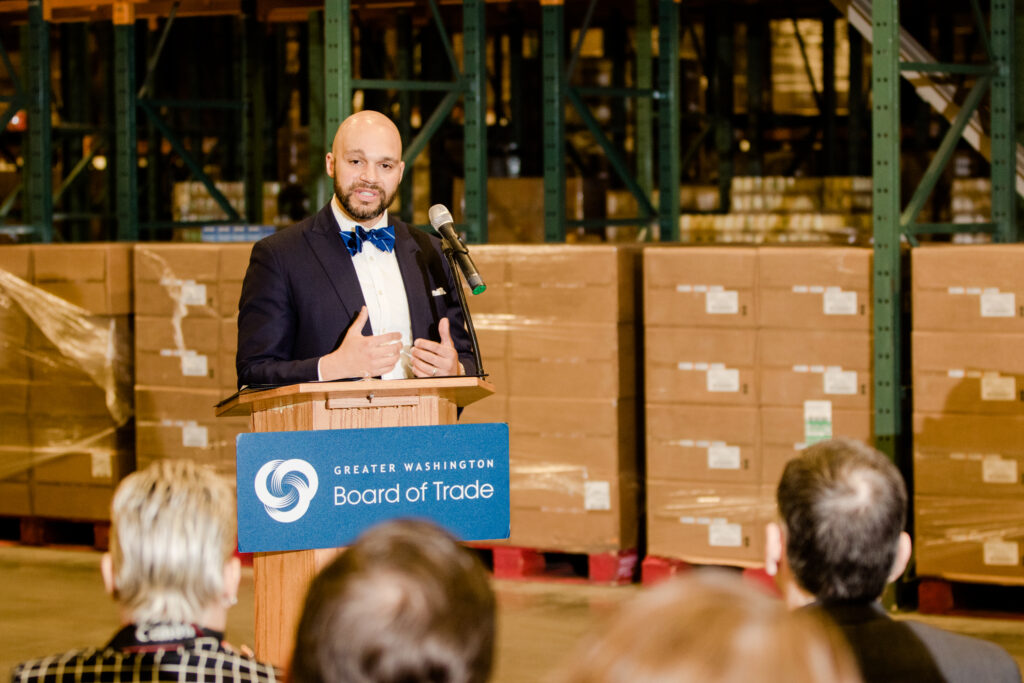
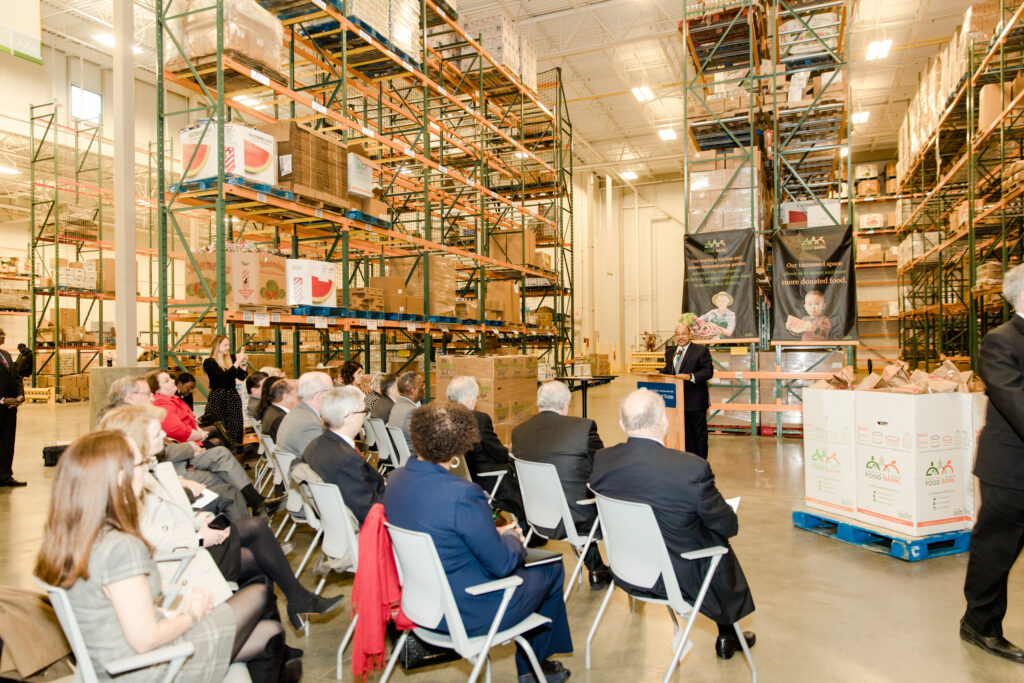
Last month, we announced a new partnership with the Consortium of Universities and the Council of Governments to make Greater Washington the nation’s leading digitally enabled region. It was a proud moment for us here in the Board of Trade office as well as for the many members who have worked hard to bring our smart region vision to life over the past several years.

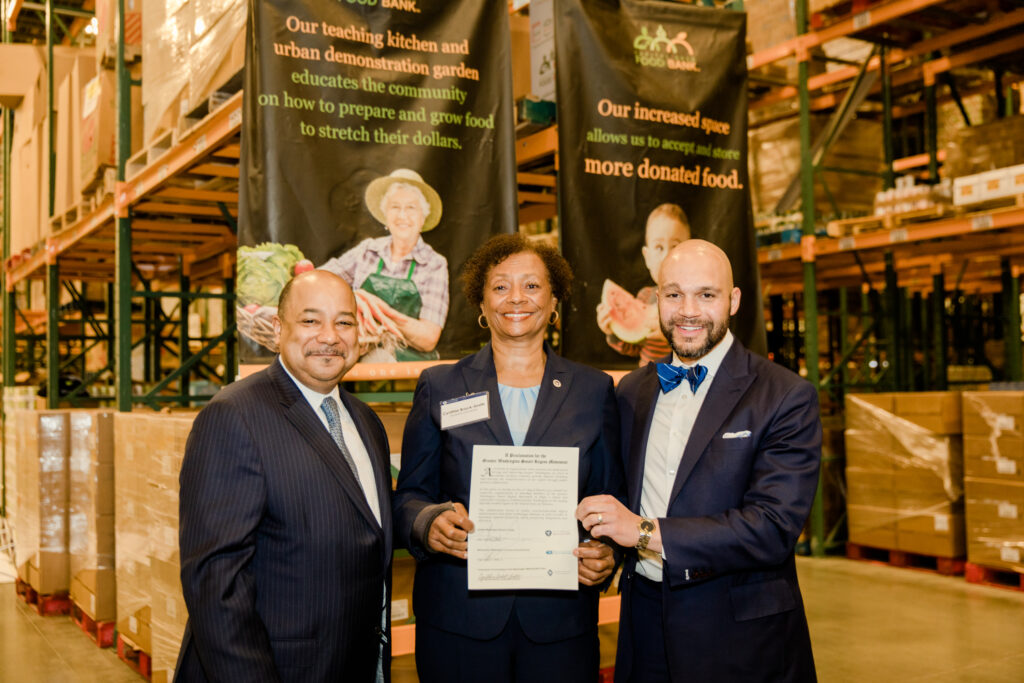
To recognize the importance of this moment, representatives of the three founding organizations made remarks and signed a proclamation of support for the Greater Washington Smart Region Movement at our March board meeting.

From left to right: Tony Lewis, chair of the Greater Washington Board of Trade and region vice president for Verizon; Cynthia Brock-Smith, assistant vice president for external affairs at Howard University; Robert White, Jr., D.C. councilmember and chair of the Metropolitan Washington Council of Governments.

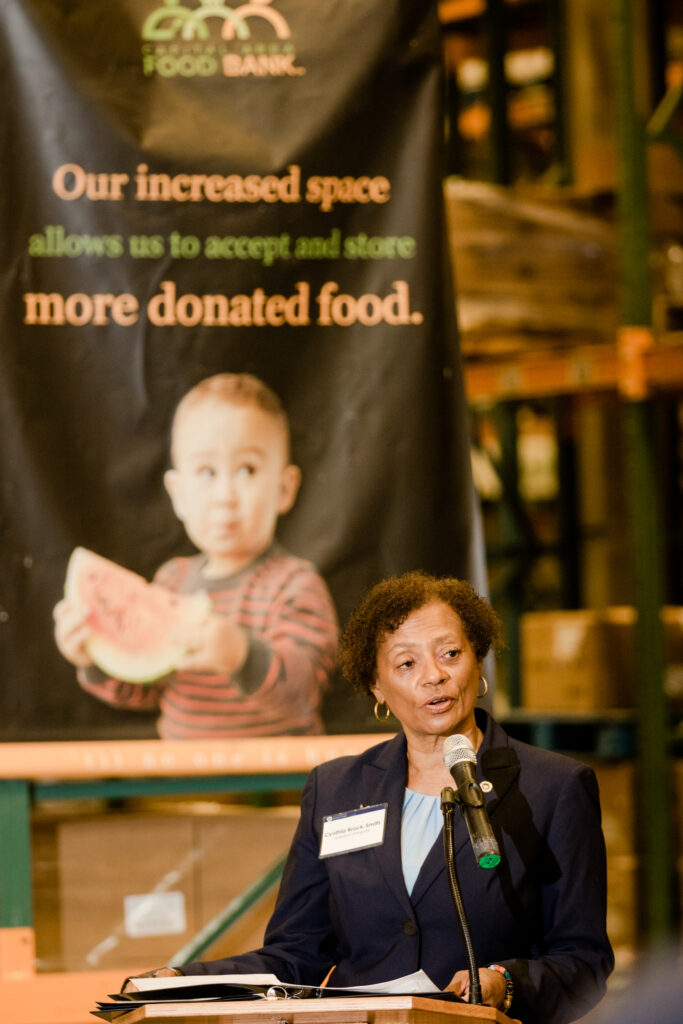
Cynthia Brock-Smith, assistant vice president for external affairs at Howard University, represented the Consortium of Universities. She said, “We feel that universities and institutions of higher education in this region are untapped resources that can help propel this region to the next level.”

Cynthia explained that Howard University has experience in some of the social, environmental, and economic issues that are being explored through this agreement. “I know many of our partners in the consortium have also been doing work that can help us with the vision,” she said. “We are here to cooperate, collaborate, and achieve results so that this is one of the best places in the world.”

Robert White, Jr., D.C. councilmember and chair of the Metropolitan Washington Council of Governments, was enthusiastically supportive of the partnership and described how it will enable technology providers and governments to better work together.

“I really couldn’t be more excited about this partnership,” said Robert. “The pace of technology and how it is intertwined with our everyday lives has increased substantially… Folks who produce technology don’t always have the same priorities as our government or our businesses. If we have an opportunity to partner and take the lead, create a framework to say, this is how we can develop D.C. into a smart region and use technology to help us with public health, transportation, improving the environment… in so many ways we can set the agenda together.”

Robert also made the case for working together as a region. “We can do that together as a region, not just D.C. working for D.C., Maryland working for Maryland, Virginia working for Virginia. We can do that collectively, and we’ll get a better bang for our buck if we continue to share priorities, and really highlight this region as a competitive place, a competitive market that can compete not only with other regions around the country but with others around the world.”

Tony Lewis, chair of the Board of Trade and region vice president for Verizon, reminded members in attendance of the big-picture opportunity created by the Greater Washington Smart Region Movement, saying, “We are going to improve the lives of 6 million people in our region, if we start, if we take the steps that are being taken today.”

Tony then urged members to actively engage in the initiative. “What happens next? We take full advantage of this opportunity. We grab this by the horns. We ask, what do we do to ensure that the level of cooperation that we saw happen with MetroNow takes on a new life? Because our governments want to help, they want our partnerships. Our students and our universities want more opportunities,” said Tony, adding “This is workforce, this is jobs, this is a better quality of life for every individual, so that those who are in need of food the most have better access to it, faster access to it, and more of it because technology finds way for us to be better citizens.”

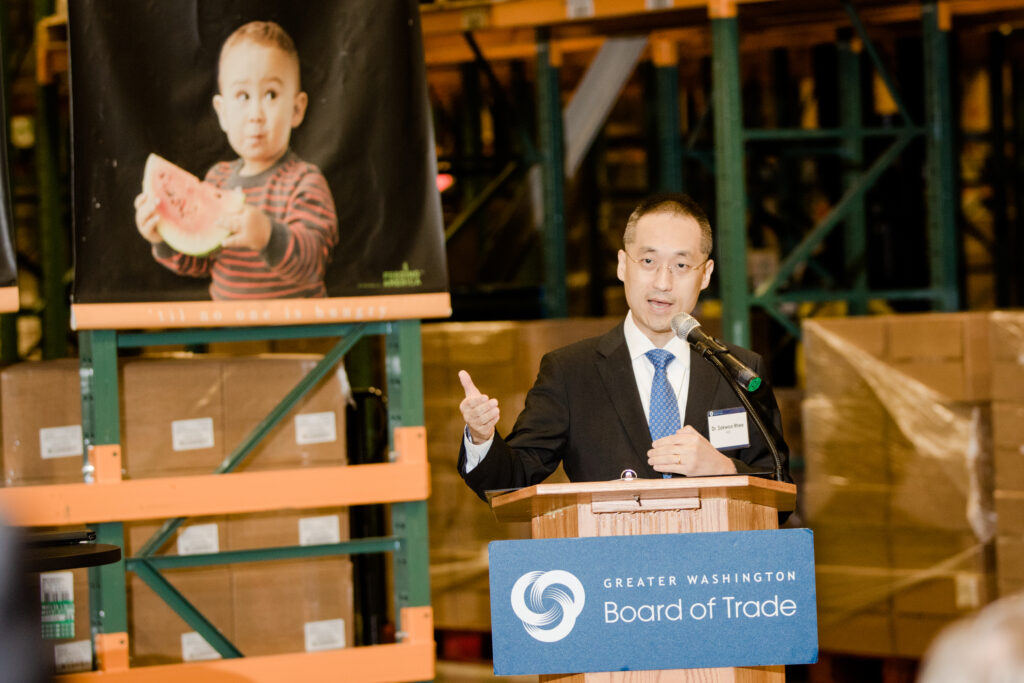
Dr. Sokwoo Rhee, associate director for Cyber-Physical Systems Innovation at the National Institute of Standards and Technology (NIST) and leader of the Global City Teams Challenge (GCTC) for SMART Cities/Regions, also shared his thoughts on the partnership. He said that this is a pivotal step in keeping the momentum going and turning ideas into real economic opportunities. He also praised the regional approach taken by the founding organizations.

To learn more about the Greater Washington Smart Region Movement and how you can get involved, contact us.

Letter of support for public-private partnerships addressing Maryland highways

March 21, 2019

Mr. Greg Slater, Administrator
Maryland State Highway Administration
707 N. Calvert Street
Baltimore, MD 21202

RE: MDOT SHA P3 Program to address congestion along the I-495 & I-270 corridors

Dear Administrator Slater:

The Greater Washington Board of Trade is the region’s premier business organization and has represented all industry sectors in Greater Washington for 130 years. We strongly support the use of a Public Private Partnership (P3) to finance the Maryland Traffic Relief Plan for I-270 and I-495, as proposed by the Maryland Department of Transportation (MDOT).

Our regional transportation network should be safe, reliable, affordable, and convenient, and this project would help us achieve these goals. The difficulty with which people and cargo move around the region has a large impact on quality of life and economic productivity. Unfortunately, commute times are a major source of stress and productivity loss in Greater Washington. According to INRIX’s 2018 Global Traffic Scorecard, our region is currently the world’s 19th most congested metropolis, with commuters spending 155 hours lost in congestion.

We need a mix of safe, convenient, and clean transportation options and we feel this project is critical to the region’s economic future and quality of life and needs to be part of any comprehensive solution. Priced managed lanes on I-495 and I-270 will reduce congestion delays and allow for an extensive, region-wide, express-bus system on those lanes, as called for in the Metropolitan Washington Council of Governments’ approved “Visualize 2045” long-range plan. The P3 approach appears to be the only viable way to finance an investment of this magnitude.

In closing, we fully support the use of tolls and a Public Private Partnership to deliver priced managed lanes on I-495 and I-270 and will continue to advocate for innovative solutions like this to the daunting transportation challenges facing our region.

Sincerely,

Jack McDougle
President and CEO
Greater Washington Board of Trade

Featured Members