From Projects to a Regional System: Six Takeaways from the 2026 Capital Region Transportation Forum
On November 4, the Greater Washington Board of Trade and Greater Washington Partnership convened the 9th Annual Capital Region Transportation Forum, bringing together public- and private-sector transportation leaders to examine what Greater Washington needs to get right as it plans for the next decade.
Across the afternoon, one idea kept surfacing: Greater Washington does not lack transportation assets, projects or ambition. The challenge is making them work together as a regional system.
Here are six takeaways from the conversation.
1. Metro’s recovery is real. So are the funding pressures ahead.
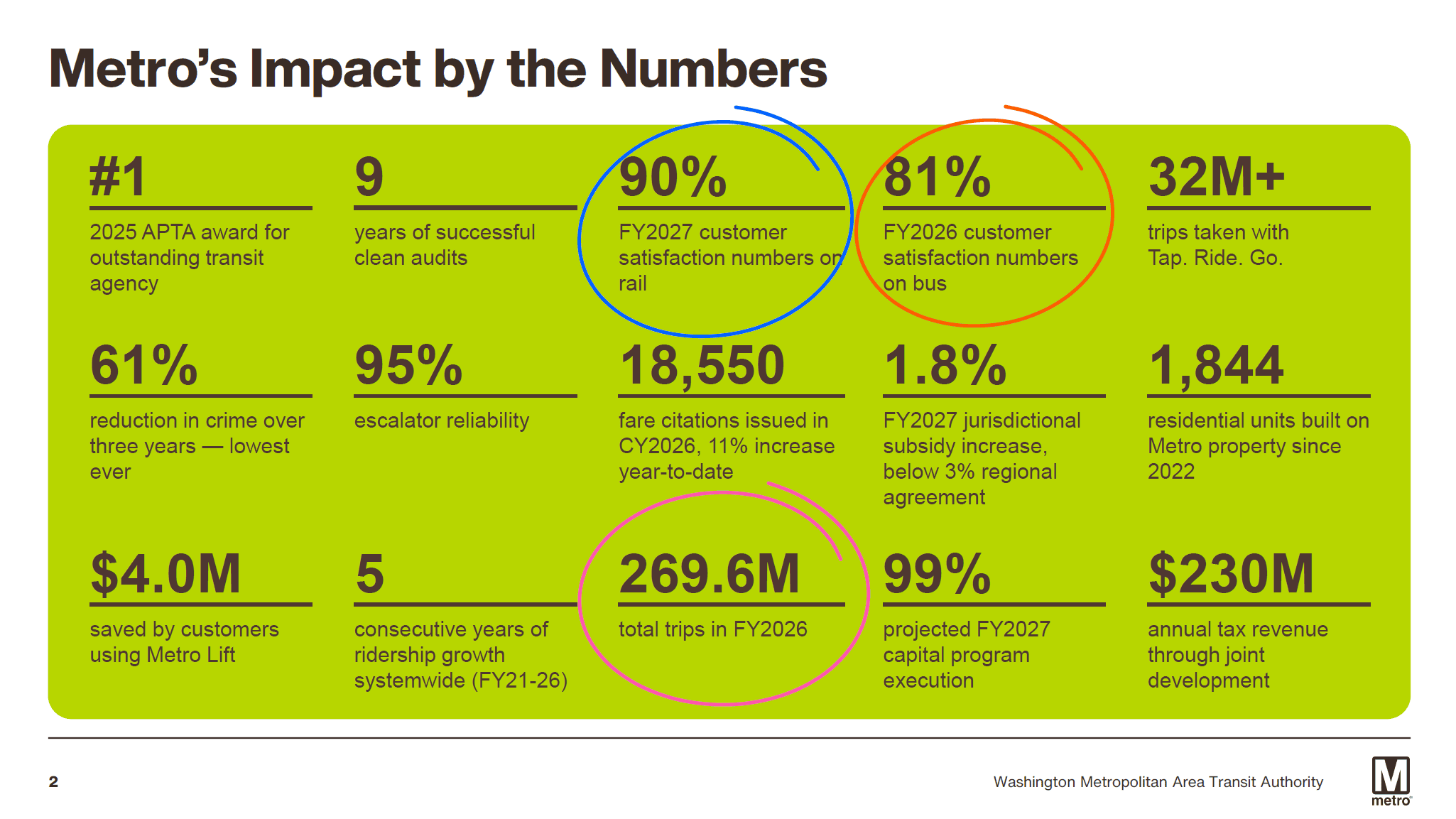
WMATA General Manager and CEO Randy Clarke opened the Forum with a strong set of indicators: nearly 270 million trips last year, an average of 950,000 weekday trips in October, the highest October ridership since 2019, and weekend ridership at its highest level since 2015. Clarke also reported that Metro recorded its lowest crime rate in the system’s history last year and is improving on that performance this year.
Those gains matter well beyond the system itself. Metro is moving roughly a million people on a typical weekday, supporting major events and tourism, connecting the region’s airports and employment centers, and helping enable transit-oriented development and new housing throughout Greater Washington.
But Clarke was equally direct about what comes next.
Metro received only 1.8 percent growth in jurisdictional operating subsidies this year while inflation was running at 3.7 percent, creating a $23 million gap that compounds in future years. His call to action centered on predictable regional funding through DMVMoves, a full 3 percent operating subsidy, continued federal partnership and regional alignment around fare enforcement.
The takeaway for the region is straightforward: Metro has regained momentum, but maintaining it will require the same level of regional commitment that helped produce the recovery.
2. Tighter resources are forcing harder choices about what gets built.
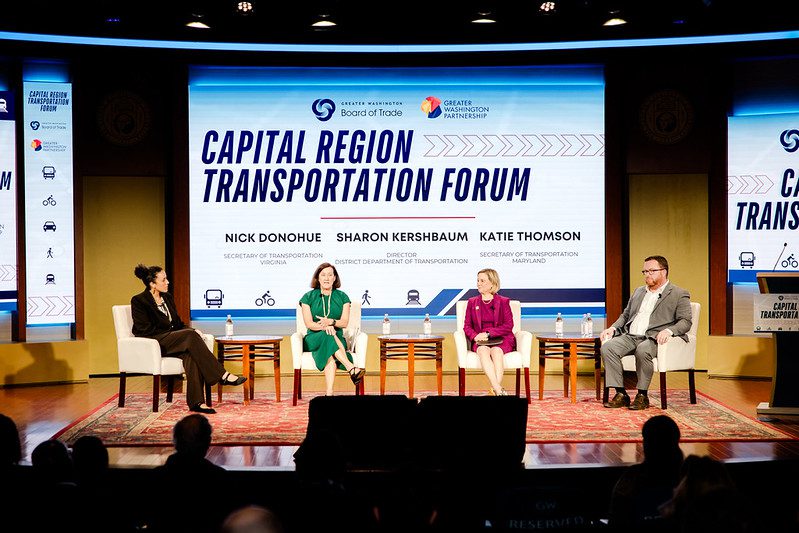
That tension carried directly into a conversation with Maryland Transportation Secretary Katie Thomson, Virginia Transportation Secretary Nick Donohue and DDOT Director Sharon Kershbaum, moderated by Jenny Gathright of The Washington Sun.
Thomson noted that Maryland has seen the cost of diesel fuel and asphalt rise 37 to 41 percent in roughly six months, adding new pressure to already constrained transportation budgets. She pointed to the Purple Line, American Legion Bridge, I-495 Southside and long-term Metro funding as examples where coordination across jurisdictions will be essential.
Kershbaum identified bus rapid transit as one of the region’s most immediate opportunities. DMVMoves has identified seven potential corridors across Greater Washington, and she argued that reliable surface transit can complement Metro while being comparatively faster and less expensive to deliver than many large capital projects. Just as importantly, those corridors need to work across jurisdictional boundaries rather than stop at them.
Donohue offered another example of doing more with the infrastructure already in place. Virginia’s I-95 express lanes move more than 50 percent more people per lane during rush hour than the general-purpose lanes, in part because they support buses, carpools and vanpools. He also pointed to Long Bridge, scheduled for completion in 2030, as a major opportunity to rethink how commuter rail connects Virginia, D.C. and Maryland.
The panelists differed on individual investments, but agreed on a larger principle: with limited resources, the region needs to be clearer about its priorities and more disciplined about getting them delivered.
3. Some transportation problems are regional by definition.
Traffic safety offered one of the clearest examples.
Kershbaum highlighted ongoing work toward reciprocity for automated traffic-enforcement violations across D.C., Maryland and Virginia. Only 18 percent of D.C. camera citations go to District residents, she said, while 29 percent go to Virginia residents and 39 percent to Maryland residents. DDOT data also show that repeat violators are significantly more likely to be involved in serious crashes. Thomson and Donohue both supported stronger regional reciprocity.
The point extends well beyond traffic cameras. Long Bridge, the American Legion Bridge, I-495 Southside, Metro funding and regional bus corridors all depend to varying degrees on decisions made by more than one jurisdiction.
For residents and businesses, those boundaries are largely invisible. The transportation system has to reflect that reality.
4. Transportation decisions are also housing and economic-development decisions.
The panel reinforced how closely transportation is connected to where Greater Washington grows.
Thomson described Maryland’s efforts to use state-owned land around transit for housing, including approximately 500 new housing units planned near the Odenton MARC station. Kershbaum pointed to RFK, Pennsylvania Avenue and the new public-space deck over Connecticut Avenue at Dupont Circle as examples of transportation and public-space projects being designed with future residents, businesses and neighborhood activity in mind. Donohue said Virginia is examining where its own street standards and traffic-impact requirements may create unnecessary barriers to transit-oriented development.
Clarke made the same connection in his State of Metro remarks, emphasizing Metro’s role as a development partner and the affordability benefit that comes when households can move from two cars to one, or from one car to none.
For the business community, this matters. Transportation affects how easily people can reach jobs, how large an employer’s accessible labor market is, where housing can grow and where private investment becomes viable.
5. A connected system requires more than new infrastructure.
The Forum’s second panel shifted from public-sector priorities to implementation, asking what it will take to finance, deliver, operate and modernize transportation as a more connected regional system.
Moderated by Yonah Freemark of the Urban Institute, Paula Dowell of HNTB, Nicolas Rubio of Meridiam, Dieter Eier of Frequentis USA and Finch Fulton of K&L Gates brought perspectives spanning infrastructure planning, private investment, technology, aviation and public policy.
Dowell argued that the real measure of connectivity is whether a traveler experiences transportation as one safe, efficient and predictable journey, regardless of jurisdiction or mode. Reaching that point will require agencies to coordinate not only physical infrastructure, but also data, operations, incident management and technology.
The panel also highlighted some of the less visible barriers to getting there. Rubio pointed to permitting and project delivery as areas where major investments can lose years even after priorities have been established, and argued that successful public-private partnerships require smarter risk sharing rather than simply shifting risk from one sector to another.
Technology creates opportunities, but only if the region plans for it differently. Dowell encouraged agencies to focus on the outcome they want rather than designing around a single technology that may be outdated by the time it is deployed. Fulton made a related regional point: emerging mobility services, including automated vehicles and first- and last-mile options, become much less useful if they can operate in one jurisdiction but cannot cross into another.
Eier brought the aviation and technology perspective, arguing that the bigger barrier is often not whether technology exists, but whether institutions can move quickly enough to deploy it. He described aviation technology that historically could take eight to ten years to implement being deployed in roughly 12 months when acceleration became a priority. He also challenged the region to think about BWI, Dulles and Reagan National as more connected parts of a regional mobility network rather than isolated assets.
The takeaway was that Greater Washington does not need to wait for the next major capital project to become more connected. There are opportunities now to remove barriers to delivery, better coordinate existing systems and create a policy and operating environment that allows new ideas to work across the region.
6. The best test of regional connectivity may be the customer experience.
Board of Trade President and CEO Jack McDougle closed the Forum with a practical example from the DMVMoves initiative.
Greater Washington has 13 different bus transit agencies. When the regional work began, those agencies did not have common wayfinding, shared call centers or even consistent definitions for categories such as student fares.
Individually, those may sound like small operational differences. For a rider trying to navigate multiple systems, they create a much bigger obstacle.
That example captured the larger theme of the Forum.
Building a more competitive transportation system does not always mean launching the next major capital project. It can also mean making existing assets work together better, prioritizing investments more deliberately, using technology and data more effectively, removing barriers to delivery and designing the system around the people and businesses that actually use it.
Greater Washington already functions as one interconnected economy. Our transportation system increasingly needs to function the same way.
Watch the full 2026 Capital Region Transportation Forum
Special Thank You
The Greater Washington Board of Trade thanks our co-host, the Greater Washington Partnership,
George Washington University for hosting the Forum, and our 2026 sponsors for their support.

Become a member today
We need your voice at the table to make Greater Washington a place where everyone can succeed