Expediting Delivery of the American Legion Memorial Bridge and I-495 & I-270 Managed Lane Project
About This Advocacy Effort:
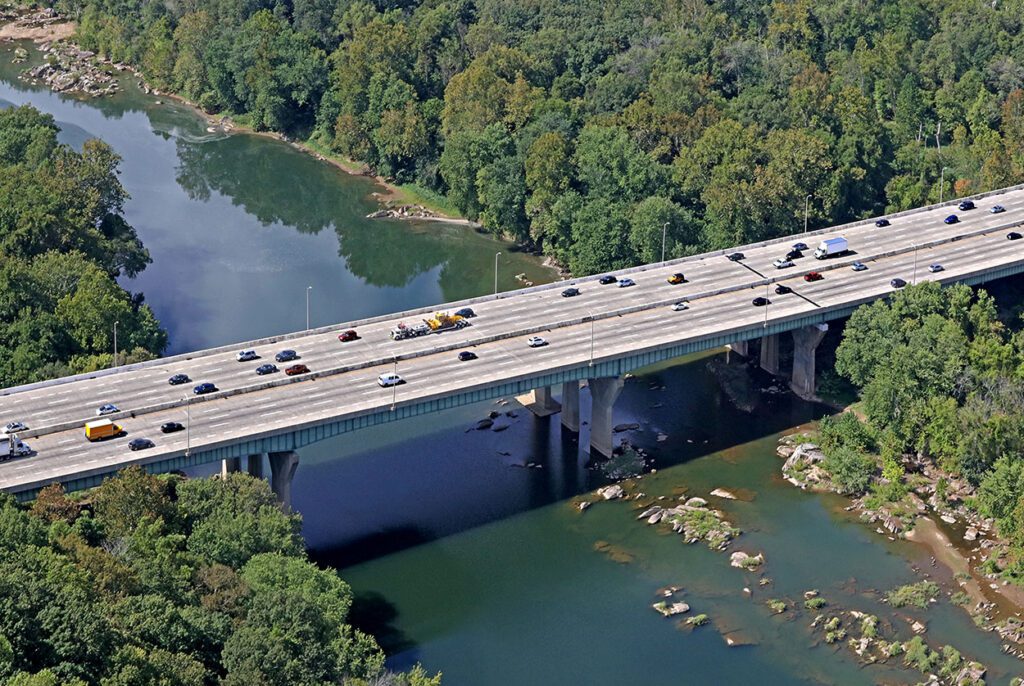
Expediting Delivery of the American Legion Memorial Bridge is a must for Greater Washington to thrive. Below is part of the Board of Trade’s response to the Federal Highway Administration’s Request for Information on accelerating delivery of the American Legion Memorial Bridge replacement and the I-495/I-270 managed lanes corridor. It outlines why the bridge is a linchpin for regional mobility and economic competitiveness—and recommends a unified, multimodal corridor approach that pairs transit integration and modern technology with a Public-Private Partnership (DBFOM) delivery model to reduce risk, attract investment, and move faster. It also highlights key barriers (funding, cross-jurisdiction complexity, regulatory uncertainty), strategies to expedite construction, and the economic cost of delay for commuters, employers, and freight movement. Read the executive summary below or download our full response.
Executive Summary
The Greater Washington Board of Trade (the Board of Trade) is the region’s premier nonpartisan business organization. For more than 135 years, we have represented all industry sectors across the District of Columbia, suburban Maryland, and Northern Virginia, serving as a primary convener to advance business competitiveness, inclusive growth, and regional livability.
Greater Washington is undergoing a profound economic transformation. The region’s historic reliance on the federal government is shifting toward a more diversified economy driven by artificial intelligence, biotechnology, cybersecurity, and other advanced industries. To remain globally competitive and to sustain the federal government’s own economic and national security interests our shared infrastructure must evolve.
Investing in the American Legion Memorial Bridge (ALMB) is therefore a strategic imperative for both Maryland and the federal government. As the bridge approaches the end of its useful life in 2028, it represents not only a critical transportation asset, but one of the most important federal–state infrastructure partnership opportunities in the nation.
While Greater Washington is now the most congested region in the United States, with daily gridlock costing billions in lost productivity, the central issue is not simply congestion. Mobility is now a core economic and national competitiveness function. The efficiency with which people and goods move determines whether the region can support federal missions, attract private investment, expand workforce participation, spur innovation, and sustain long-term growth.
We Cannot Compete Through Congestion
Greater Washington’s roadway system is fundamentally constrained. Unlike most major metropolitan regions, which benefit from inner and outer beltways, the Capital Region relies on a single overburdened loop to serve both local and national travel demand. Every chokepoint now carries national economic consequences.
Relying solely on traditional public funding for multibillion-dollar infrastructure investments is neither feasible nor equitable. Competing with global hubs such as London, Toronto, and Houston requires demonstrating a willingness at both the state and federal levels to invest now, responsibly and creatively, in the systems that underpin long-term competitiveness.
A Unified, Multimodal Corridor Strategy
The solution is not piecemeal projects, but a unified, multimodal corridor strategy for the I-270 and I-495 system. Given limited physical space and a single Capital Beltway, the objective must be to maximize throughput.
This requires integrating highways, transit, and technologies where rail, bus, and roadways operate as a single ecosystem. Only through this level of integration can the region meaningfully reduce congestion, improve reliability, and support long-term economic growth.
In 2019, the Board of Trade and the Greater Washington Partnership convened the Capital Regional Transportation Forum, leading to the Capital Beltway Accord, a joint Maryland–Virginia commitment to address the ALMB bottleneck and pursue a coordinated corridor strategy.
The replacement and modernization of the American Legion Memorial Bridge is the linchpin of this system and a cornerstone of North–South regional connectivity. The South Side Project is equally critical, unlocking the eastern and southern Beltway, improving freight movement, expanding access to jobs and housing, and strengthening trip reliability across the metropolitan area.
Leveraging P3s and Federal Investment
These projects are too critical and too large to be delivered through state level public funding alone. Public-Private Partnerships (P3s), supported by strong federal investment, should serve as a core delivery mechanism for the corridor.
P3s enable faster project delivery, introduce private-sector innovation, transfer risk, and unlock substantial private capital while positioning Maryland to maximize federal investment and meet USDOT’s expectations for performance, cost discipline, and schedule certainty.
We recommend a Public-Private Partnership using a Design-Build-Finance-Operate-Maintain (DBFOM) revenue-risk model to align federal priorities, state leadership, and private capital around long-term performance, accountability, and regional impact. This approach not only adds capacity to the corridor, but it introduces demand management in the form of dynamically priced express lanes, which offer reliable travel times for drivers when they need it and are willing to pay for it. This travel time reliability is also enjoyed by transit riders, as transit vehicles will use the express lanes at no cost.
By advancing a unified federal–state strategy that leverages private investment and modern delivery models, Maryland and the federal government can transform the region’s transportation system from a structural constraint into a national competitive asset.
Additional Advocacy Around This Topic
Letter of Support for Proposed I-495 Southside Express Lanes Project
Letter of Advocacy: Maryland and Virginia must Prioritize Reconstruction of American Legion Bridge
Become a member today
We need your voice at the table to make Greater Washington a place where everyone can succeed