Executive Leadership Roundtable Recap: What Regional Leaders Are Watching
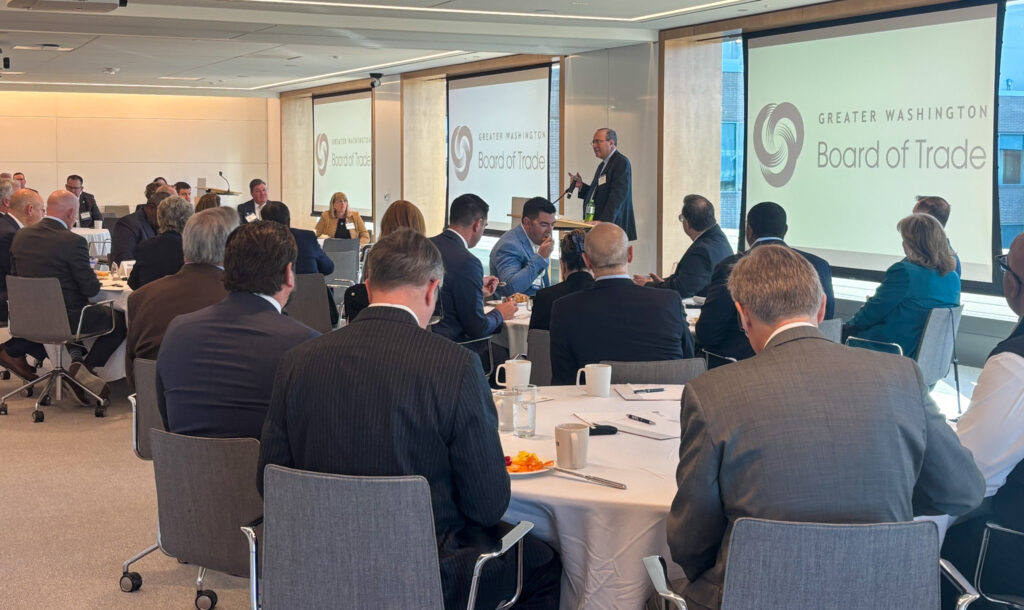
When conditions feel wobbly underfoot, the horizon matters most. Near-term signals can shake; what counts is the broader trajectory—and how leaders adapt. To compare notes on shifting conditions in the region, senior executives met on October 17 at Akin Gump Strauss Hauer & Field’s Washington, D.C., office for a candid Executive Leadership Roundtable with Tom Barkin, President & CEO of the Federal Reserve Bank of Richmond. The value came from leaders comparing notes in real time, connecting front-line experience with broader economic context.
Several recurring trends emerged
People & Demand
Hiring remains muted but stable—a low-hire/low-fire posture with attrition doing most of the work. Candidate availability has improved across many roles, but skilled trades, childcare, and eldercare remain tight. On the demand side, consumers are choosier and value-seeking, trading down (e.g., private label; repair vs. replace), with meaningful variability by sector.
Productivity & Operating Models
To protect margins, many firms are leaning into process redesign, automation, and practical AI—especially in support workflows (documentation, collections, customer contact). In practice, these moves often substitute for incremental hiring while leaders monitor service quality and outcomes.
Systems & Infrastructure
Capital planning assumes multiple interest-rate paths rather than a single trajectory. Supply chains continue to localize (“local-for-local”) where feasible as trade policy evolves. Meanwhile, accelerating demand from AI/data centers is colliding with long lead times for generation and transmission—raising near-term questions about power readiness. In commercial real estate, office softness (particularly B/C space in large cores) contrasts with relative strength in industrial, logistics, and data-center assets; the DMV feels the office adjustment more acutely than many markets.

Why it matters
The throughline wasn’t a single indicator; it was operating adaptation. Old playbooks map poorly to today’s pace and complexity. What’s working now: diversified talent strategies, productivity investments (including practical AI), financial flexibility, and regional alignment on housing and transportation to keep our talent advantage.
What leaders are watching next
- Labor fit: Will skills pipelines (training, credentials, migration) keep pace with role requirements?
- Cost pass-through vs. productivity: Can process/tech gains continue to offset input costs without eroding service?
- Grid readiness: How quickly can generation/transmission investments meet data-center demand without bottlenecks?
The Board of Trade will continue convening executive-level dialogues that surface timely insights and connect them to practical action for our region.
Thank you to the Federal Reserve Bank of Richmond and Akin Gump Strauss Hauer & Field for partnering on this vital discussion that engages our members and partners in the region.


Become a member today
We need your voice at the table to make Greater Washington a place where everyone can succeed